
xLM Joins Hyland to Power Trusted Enterprise AI Platform
Discover how xLM and Hyland enable trusted enterprise AI through intelligent content, AI governance, explainable AI, compliance, and context-aware automation.

share this
1.0. Introduction
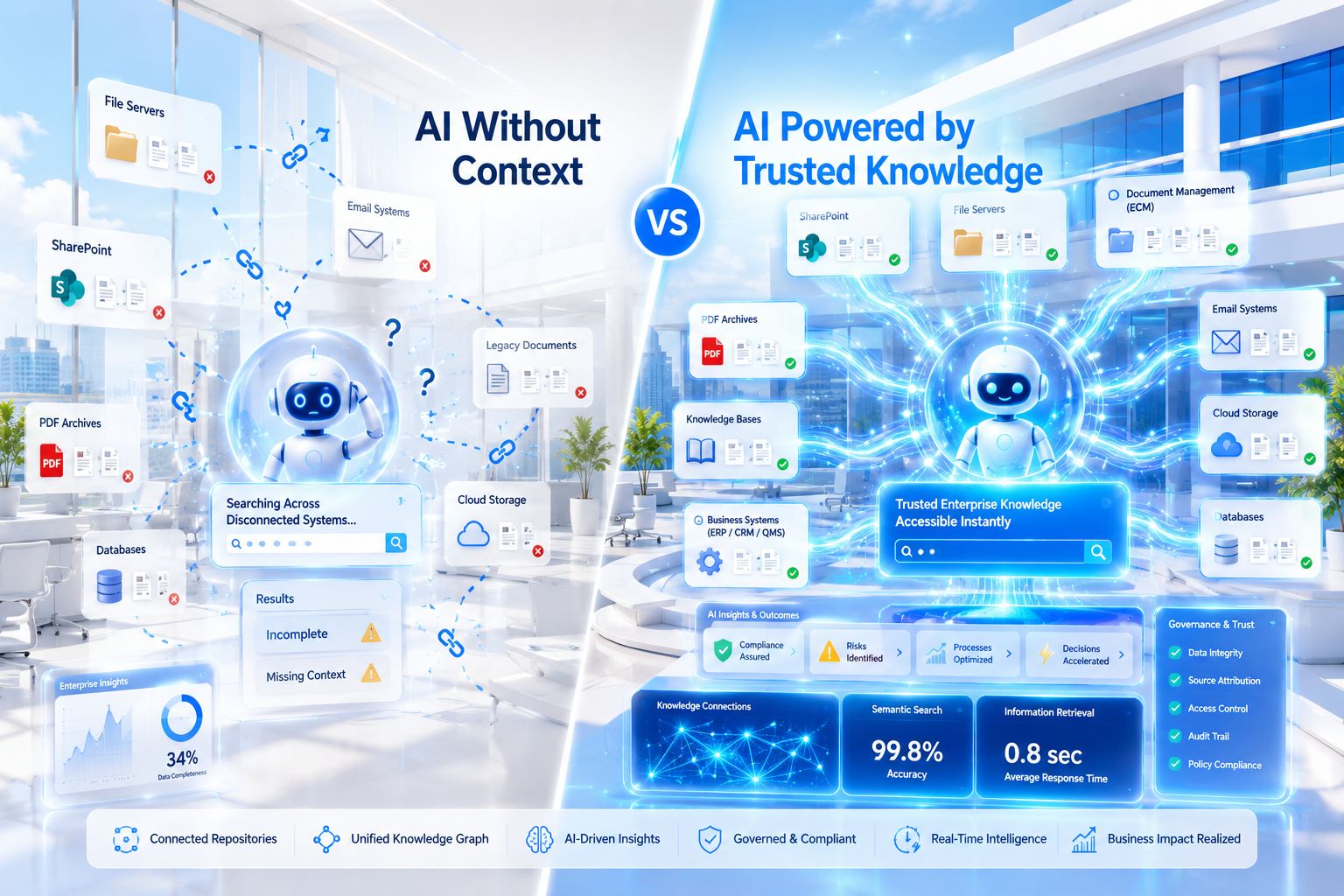
Organizations have invested millions in AI platforms, copilots, and automation. Yet the intelligence driving those systems often disconnects from the knowledge defining how the business operates.
The problem isn't the model. It's the enterprise content the model cannot see, understand, or trust.
Across regulated industries, real enterprise knowledge lives inside SOPs, validation reports, quality records, engineering documents, contracts, emails, and decades of operational experience. Most remain locked in disconnected repositories, inaccessible to AI meaningfully.
If you lead AI initiatives in a regulated environment, this gap already affects you. AI isn't failing because it's incapable; it's failing because it operates without context.
2.0. The Blind Spot Most Enterprise AI Strategies Miss
Every organization wants AI that reasons, recommends, and automates decisions.
But reasoning requires evidence.
When AI cannot access governed enterprise knowledge, it fills gaps with probability instead of certainty. The result is confident answers lacking traceability, business context, and explainability.
That's where operational risk begins.
Imagine a pharmaceutical manufacturing site preparing for an FDA inspection. An investigator asks for evidence supporting a process change from eighteen months ago. The documentation exists but scatters across multiple systems, emails, and archived validation packages. Finding the complete audit trail takes days instead of minutes.
The audit became difficult not because of regulation but because knowledge was fragmented.
Now consider a different scenario.
A customer support AI recommends an outdated operating procedure because the latest approved SOP never connected to its knowledge source.
AI didn't fail here. Your content architecture did.
3.0. Enterprise Content Is No Longer Storage—It's Enterprise Intelligence
For years, enterprise content management focused on storing information securely.
That no longer suffices.
Enterprise content must become active intelligence that AI can retrieve, understand, reason over, and use within governed business processes.
Consider where enterprise AI is headed.
AI copilots embed into daily operations. Autonomous agents execute business workflows. Digital twins monitor manufacturing environments. Decision systems adapt continuously to changing conditions.
None of these capabilities create business value if underlying knowledge is incomplete or untrusted.
The competitive advantage lies not in having more documents but in making those documents computational.
4.0. Why the xLM and Hyland Partnership Matters
This is why our partnership with Hyland is so significant.
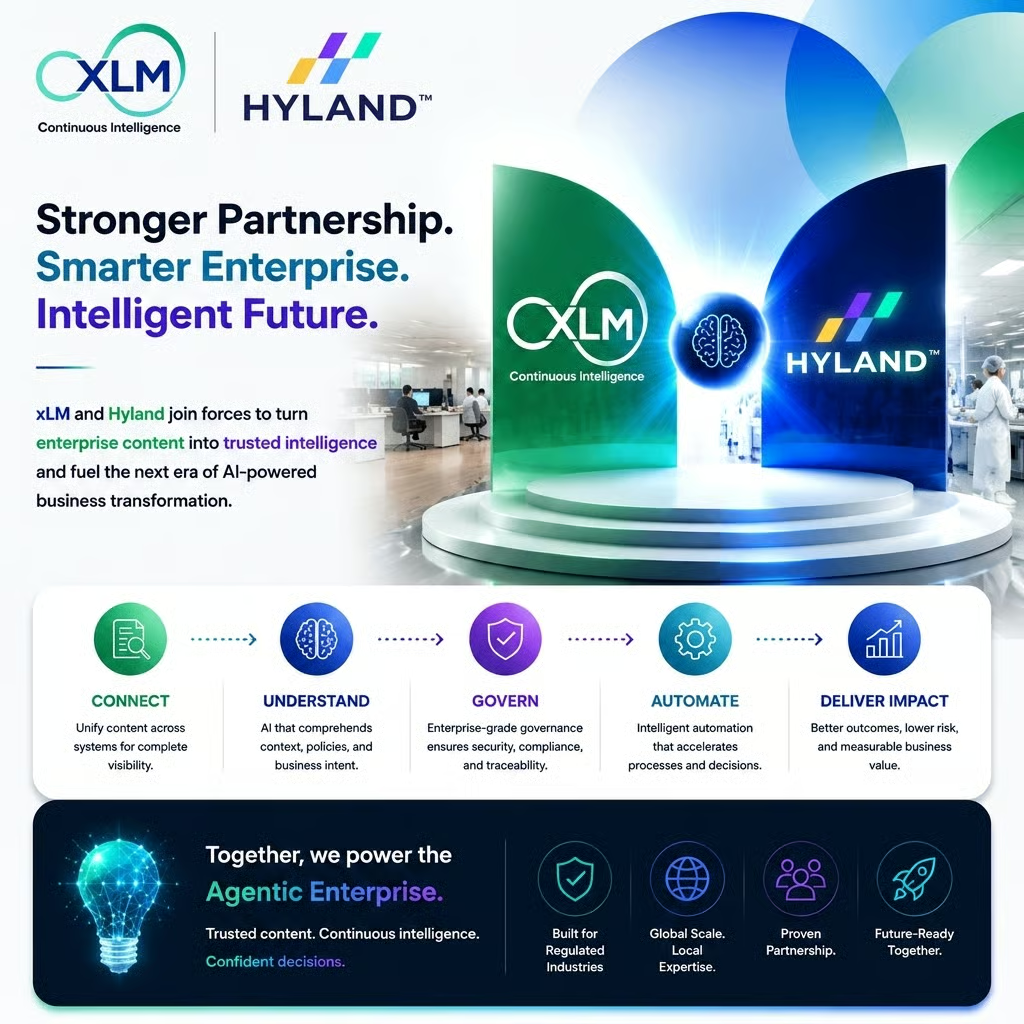
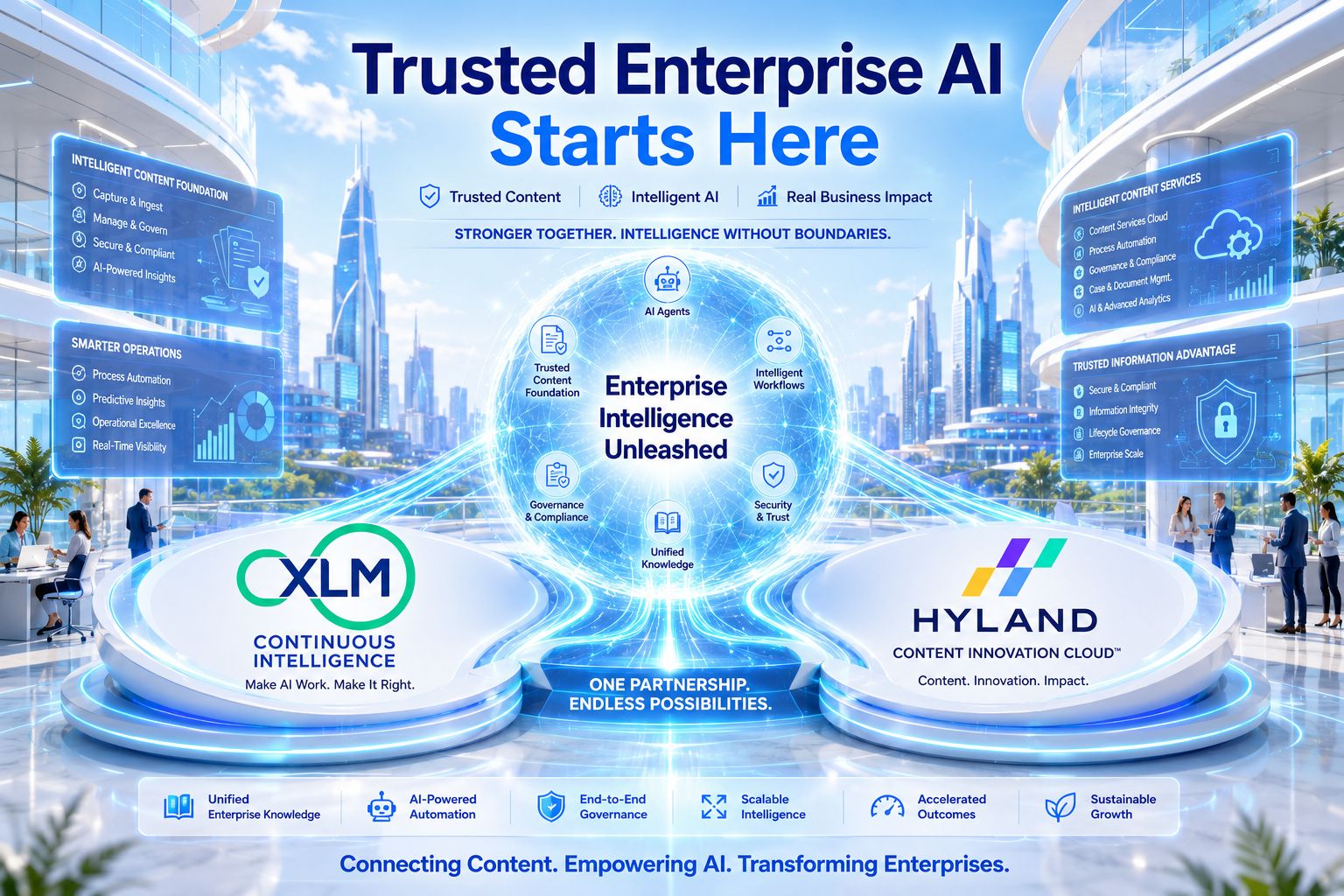
We proudly announce that xLM - Continuous Intelligence has joined the Hyland Global Partner Network, bringing together Hyland's industry-leading Content Innovation Cloud with xLM's AI-driven Continuous Intelligence platform.
This partnership brings together Hyland's content intelligence foundation with xLM's expertise in AI, governance, and regulated industry operations.
Here's what that means in practice.
Before:
Enterprise content sits across disconnected repositories. Employees search manually. AI answers without understanding business context. Audit evidence assembles after the fact.
After:
Enterprise content becomes connected and governed. AI performs context-aware retrieval across trusted knowledge sources, generates policy-grounded recommendations, maintains complete audit trails, and supports explainable decision-making from the start.
That's a fundamentally different operating model.
5.0. From Documents to Intelligent Decisions
Consider a manufacturing deviation.
Traditionally, quality teams search multiple systems for SOPs, historical deviations, CAPAs, validation reports, and change controls before starting an investigation.
Now imagine the same event in an intelligent content environment.
AI immediately retrieves relevant SOPs, correlates historical deviations, identifies similar investigations, evaluates potential compliance impact, and presents recommendations backed by verifiable evidence.
Every recommendation includes its source. Every decision is traceable. Every action is auditable.
Or think about a product release delayed because critical validation knowledge was buried in archived project documentation. Hours become days, and days become costly production delays.
When enterprise knowledge is connected and AI-ready, those delays become opportunities for faster, more confident decisions.
That is the operational value of intelligent content.
6.0. Trust Becomes the Foundation of Enterprise AI
In regulated industries, trust cannot be added later. It must be designed into every workflow.
AI must demonstrate why it reached a conclusion, which approved documents it referenced, whether policies were followed, and how every recommendation can be reproduced during an inspection.
If your AI cannot cite your own SOPs, it is not enterprise-ready.
Hyland provides enterprise-grade governance, lifecycle management, and secure content services.
xLM extends that foundation with Continuous Intelligence, AI governance, GxP expertise, Continuous Validation, and intelligent automation designed for highly regulated environments.
Together, organizations gain more than automation.
They gain confidence that AI can operate at enterprise scale without compromising compliance.
The success of AI in pharmaceutical manufacturing depends just as much on training, organizational adoption, governance, and cross-functional collaboration as it does on the performance of AI models themselves.
7.0. Building the Agentic Enterprise
The next generation of enterprise software will not simply assist people. It will collaborate with them.
Autonomous AI agents will review documents, orchestrate workflows, investigate deviations, support audits, and accelerate business operations.
But every agent depends on one critical capability: access to trusted enterprise knowledge.
Without that, autonomous systems simply automate uncertainty.
Hyland provides the intelligent content foundation, and xLM delivers domain-aware AI orchestration. Together, they enable organizations to build agents that operate with context, governance, and accountability not just speed.
8.0. The Future of Enterprise AI Is Built on Trusted Knowledge
This partnership represents more than content management.
It represents a new enterprise architecture where content is no longer passive, AI is no longer ungrounded, and decisions are no longer opaque.
Knowledge becomes connected. Content becomes intelligence. AI becomes explainable.
And enterprises become ready for the next generation of intelligent operations.
The winners won't be the organizations with the most AI. They'll be the ones whose AI can prove why it's right.
9.0. About the Authors
Nagesh Nama
CEO, xLM Continuous Intelligence | Founder, ValiMation
Nagesh is a pioneer in AI/ML-driven GxP compliance with nearly three decades of experience helping pharmaceutical, biotech, and medical device companies navigate validation, data integrity, and regulatory compliance. He is the founder and CEO of both ValiMation (founded 1996) and xLM Continuous Intelligence — the company that first introduced a Continuous Validation platform supporting IaaS/PaaS/SaaS environments compliant with 21 CFR Part 11 and Annex 11. Today, xLM offers a comprehensive suite of continuously validated AI/ML managed services spanning intelligent validation (cIV), predictive maintenance, temperature mapping, and GxP AI agents. Nagesh is a member of the Forbes Technology Council and the Fast Company Executive Board, a contributor to Forbes and Fast Company, and has been featured on Microsoft's AI Agents Vlog. He holds an M.S. in Manufacturing Engineering from the University of Massachusetts, Amherst.
Kashyap Joshi
Program Manager, AI/ML ContinuousOS Apps | xLM Continuous Intelligence
Kashyap Joshi is a Program Manager at xLM, where he leads the implementation of complex AI systems for life sciences organizations by aligning stringent GxP regulatory requirements with next‑generation technology and xLM’s ContinuousOS Suite of Apps to deliver measurable ROI, continuous compliance, and long‑term transformation for clients across pharma, biotech, and medical devices.
share this