
Future of AI in Pharmaceutical Manufacturing Explained
Explore the future of AI in pharmaceutical manufacturing with Continuous Validation, Agentic AI, GxP compliance, trusted governance, and intelligent operations.

share this
1.0. Introduction: AI Is Redefining Pharmaceutical Manufacturing
The manufacturing industry is undergoing a major technological transformation since automation began. As Industry 4.0 evolves into intelligent and connected operations, Artificial Intelligence (AI) drives the next wave of innovation. Organizations use AI not only to automate repetitive tasks but also to optimize production planning, predict equipment failures, improve quality control, reduce energy use, and create decision-making systems that learn from operational data.
In industries like automotive, aerospace, electronics, and consumer goods, AI-powered systems are integral to manufacturing. Digital Twins simulate production in real time, Computer Vision detects defects within milliseconds, and Predictive Maintenance models analyze equipment to prevent downtime. AI also enables smarter inventory management, adaptive scheduling, and supply chain optimization for greater agility and resilience.
These capabilities shift manufacturing from a reactive operating model to a predictive and intelligent enterprise where decisions rely on data-driven insights.
However, while AI adoption has accelerated in general manufacturing, pharmaceutical manufacturing has yet to transform at the same pace. Despite interest, many life sciences organizations struggle with enterprise-wide adoption. The challenge is not innovation but ensuring every AI decision meets strict GxP, FDA, and GMP standards while maintaining patient safety, data integrity, and regulatory compliance.
The next generation of pharmaceutical manufacturing will be defined not just by AI adoption but by how responsibly AI is governed, validated, and trusted.
2.0. Why Pharmaceutical Manufacturing Faces Unique AI Challenges
Pharmaceutical operations operate under strict regulatory oversight. Every production activity, system configuration, process change, and quality decision requires full documentation, validation, and traceability throughout its lifecycle.
In most manufacturing sectors, deploying an AI model that improves efficiency is an operational decision. If it shows business value, deployment can proceed quickly under standard IT governance. In pharmaceutical manufacturing, introducing AI demands more than performance evaluation. Organizations must prove AI systems are validated, explainable, auditable, and operate consistently without compromising product quality or patient safety.
Digital transformation in life sciences has focused on digitizing existing processes rather than redesigning them. Many critical workflows, including batch record review, change control, deviation management, CAPA, computer system validation (CSV), and quality documentation still rely heavily on manual effort.
Data governance is another major challenge. AI systems depend on large volumes of confidential, regulated operational data. Organizations must ensure every dataset maintains complete data provenance, complies with ALCOA+ principles, and protects sensitive information from unauthorized access. AI outputs must remain explainable, reproducible, and free from hallucinations that could harm compliance or decisions.
These factors explain why pharmaceutical organizations adopt AI more cautiously than other industries.
Though AI technologies may seem similar across industries, implementation requirements differ greatly.
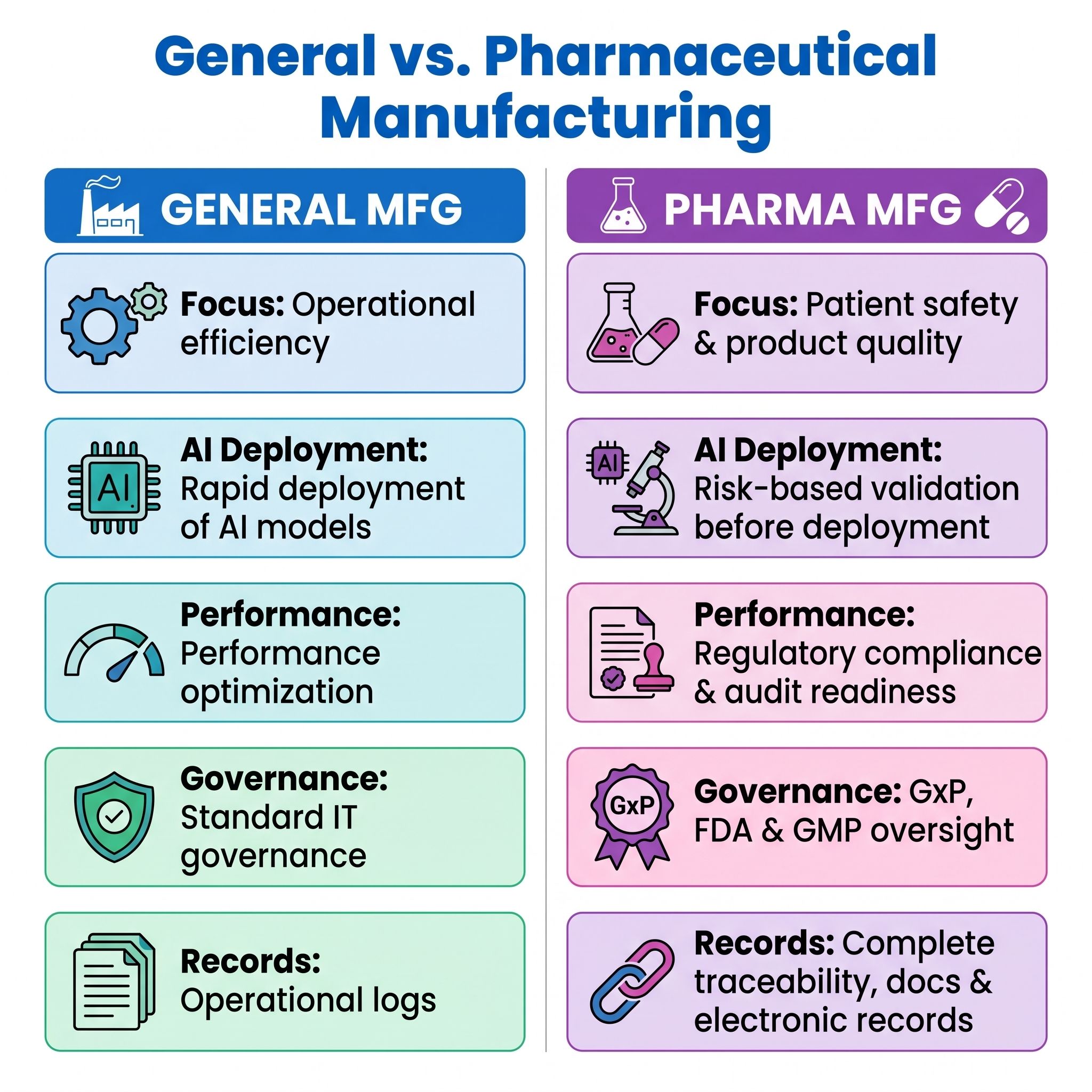
This distinction shows why adapting AI solutions from traditional manufacturing is insufficient for regulated environments. Pharmaceutical organizations need AI architectures that prioritize governance, validation, and compliance in every workflow.
3.0. Regulatory Guidance Is Creating a Clear Path Forward
Uncertainty about AI governance slowed pharmaceutical adoption. That is now changing. Regulatory authorities like the European Medicines Agency (EMA) and the U.S. Food and Drug Administration (FDA) have issued guidance clarifying responsible AI use in regulated environments. These frameworks balance innovation with compliance.
Guidance emphasizes that AI should augment human expertise rather than replace it, keeping qualified personnel accountable. Organizations should adopt a risk-based approach with validation and oversight proportional to AI's use and impact.
Comprehensive data and model governance is crucial. Organizations must document data provenance, validate models with fit-for-purpose data, maintain version control, monitor performance, and detect data drift before it affects quality. Detailed documentation should allow inspectors to understand AI development, validation, deployment, and monitoring.
Successful AI adoption now means establishing governance that ensures AI stays trustworthy, transparent, and compliant.
4.0. From Standalone AI Tools to AI Operating Systems
Many organizations start AI adoption with isolated tools for documentation, quality review, predictive analytics, or knowledge management. While these improve productivity in departments, they create fragmented AI ecosystems with inconsistent governance and limited interoperability.
As AI use grows, organizations need a unified framework to orchestrate AI across multiple regulated processes.
This need drives the concept of an AI Operating System. Instead of another AI application, it provides infrastructure to manage intelligent agents, orchestrate workflows, enforce governance, monitor models, and maintain compliance enterprise-wide.
For regulated industries, this embeds governance, validation, security, and auditability into the architecture, enabling scalable AI with regulatory confidence.
An example is ContinuousOS, by xLM-continuous intelligence, a compliance-first AI Operating System for regulated GxP environments.
5.0. ContinuousOS: Embedding Compliance into AI Workflows
ContinuousOS by xLM transforms manual digitization into continuously intelligent operations. Unlike tools that digitize manual tasks, ContinuousOS is a compliance-first intelligent OS for regulated pharma environments. It offers a modular ecosystem of autonomous AI agents executing GxP workflows with traceability, auditability, regulatory alignment, and scalability.
Central to ContinuousOS are composable GxP primitives, intelligent building blocks that automate regulated workflows across operations. These primitives support AI-powered content generation, robotic process automation (RPA), autonomous software validation, predictive analytics and continuous monitoring, and intelligent vendor audits and compliance governance.
ContinuousOS integrates specialized agents including the URS Agent, Validation Plan Agent, Test Script Agent, TraceMatrix Agent, Browser Validation Agent, Desktop Validation Agent, Mobile Validation Agent, Predictive Maintenance Agent, Continuous Temperature Mapping Agent, Environmental Monitoring Agent, and Vendor Audit Agent.
This architecture shifts compliance from post-execution evidence generation to embedding it directly into workflows through continuously intelligent systems. Instead of treating governance as a downstream activity, ContinuousOS makes it integral to planning, executing, monitoring, and validating regulated work.

6.0. Continuous Validation: The Foundation for Trusted AI
Traditional validation suits software that changes rarely. AI systems evolve continuously as data, models, and processes change, so validation must be ongoing.
Continuous Validation monitors, assesses, and revalidates AI throughout its lifecycle. Risk assessments, validation evidence, testing, performance metrics, and changes become part of ongoing governance, not isolated milestones.
ContinuousOS supports this by monitoring AI behavior, documenting changes, maintaining validation records, and identifying risks before they affect regulated operations. This maintains compliance and reduces manual validation effort.
Compliance must not be an afterthought for AI. Embed it in every workflow, decision, and intelligent agent from the start.
7.0. Agentic AI and Modular GxP Intelligence
Agentic AI involves autonomous software agents collaborating to execute complex business workflows within defined governance boundaries.
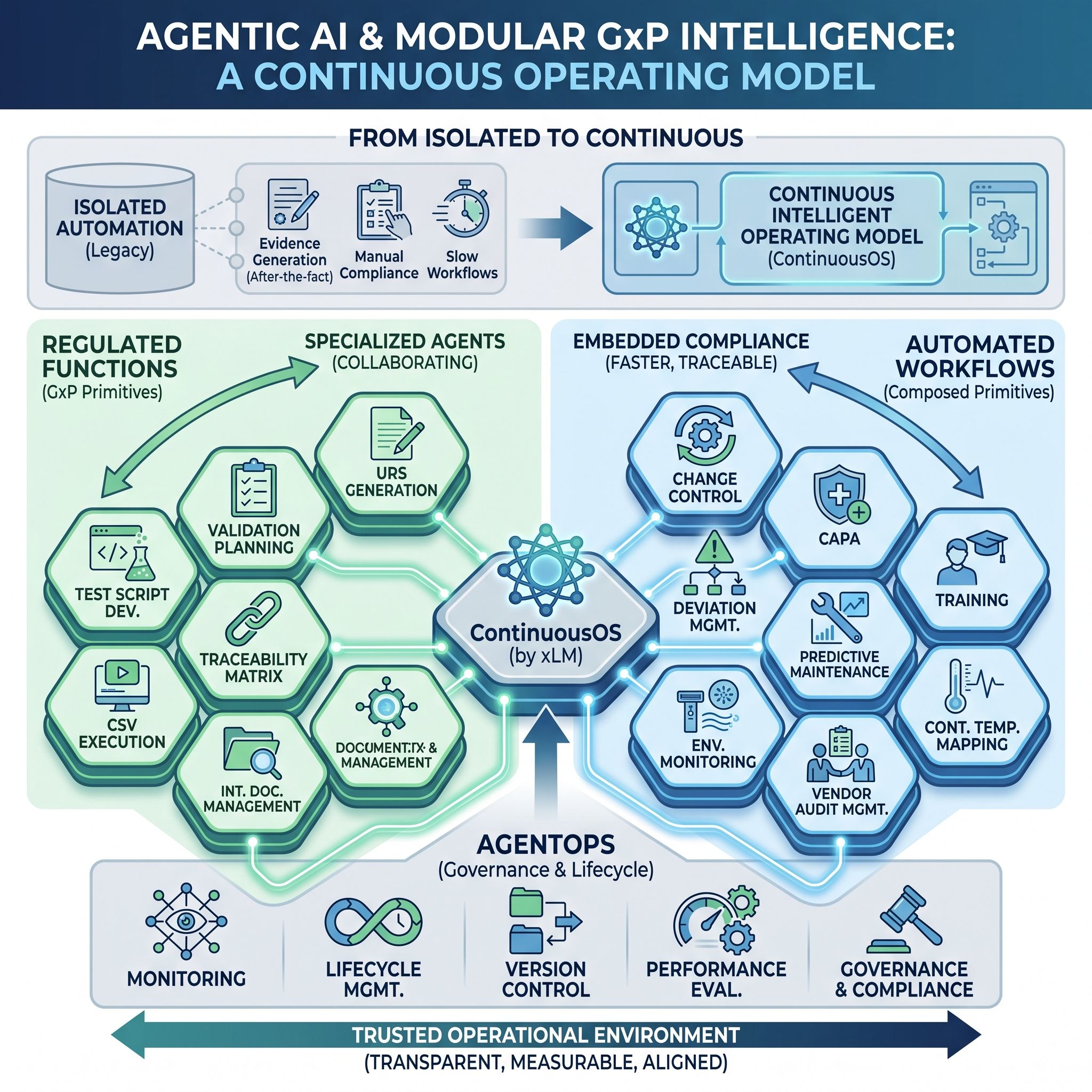
In regulated pharmaceutical environments, this model gains power when paired with modular GxP intelligence. Instead of a single monolithic AI application, ContinuousOS by xLM lets organizations deploy specialized agents for distinct regulated functions. These agents support User Requirements Specification (URS) generation, Validation Planning, Test Script Development, Traceability Matrix creation, CSV execution, and intelligent documentation management, all aligned with compliance requirements.
This modular approach uses reusable GxP primitives that standardize regulated processes, making automation, governance, and scaling easier. By composing these primitives into workflows, organizations automate activities like change control, CAPA, deviation management, training, documentation, predictive maintenance, continuous temperature mapping, environmental monitoring, and vendor audit management.
This shifts from isolated automation to a continuously intelligent operating model. Instead of generating compliance evidence afterwards, ContinuousOS embeds compliance into the workflow. This lets regulated teams move faster while maintaining traceability, auditability, and regulatory alignment in pharmaceutical manufacturing.
Complementing this is AgentOps, which provides continuous monitoring, lifecycle management, version control, performance evaluation, and governance for AI agents. Together, these create a trusted operational environment where AI stays transparent, measurable, and aligned with organizational and regulatory requirements.
The future of pharmaceutical manufacturing combines human expertise with intelligent automation, backed by continuous governance, validation, and trust.
8.0. The Future of AI in Pharmaceutical Manufacturing
AI is becoming strategic in manufacturing. For pharmaceutical organizations, success depends on deploying powerful AI and building governance to operate it responsibly.
As regulations evolve, AI's future will focus on continuous validation, transparent governance, Human-in-the-Loop oversight, and enterprise-wide orchestration instead of isolated automation. Organizations embracing these will improve efficiency, innovation, compliance, and regulatory confidence.
Platforms like ContinuousOS by xLM-continuous intelligence show how AI can evolve from standalone tools to comprehensive frameworks supporting intelligent, compliant, and scalable pharmaceutical manufacturing.
Ultimately, pharmaceutical AI's future is not replacing human expertise but augmenting it with trusted, governed intelligence. Combining Agentic AI, continuous compliance, robust governance, and modular GxP workflows, life sciences can build resilient digital operations that deliver innovation while preserving quality, safety, and trust.
9.0. Related Articles
- #112: FDA's New AI Guidance and Continuous AI Credibility
- #110: AI Agents in GxP Manufacturing: A Competitive Necessity
- #108: ContinuousOS for AI-Driven GxP Operations in Pharma
10.0. About the Authors
Nagesh Nama
CEO, xLM Continuous Intelligence | Founder, ValiMation
Nagesh is a pioneer in AI/ML-driven GxP compliance with nearly three decades of experience helping pharmaceutical, biotech, and medical device companies navigate validation, data integrity, and regulatory compliance. He is the founder and CEO of both ValiMation (founded 1996) and xLM Continuous Intelligence — the company that first introduced a Continuous Validation platform supporting IaaS/PaaS/SaaS environments compliant with 21 CFR Part 11 and Annex 11. Today, xLM offers a comprehensive suite of continuously validated AI/ML managed services spanning intelligent validation (cIV), predictive maintenance, temperature mapping, and GxP AI agents. Nagesh is a member of the Forbes Technology Council and the Fast Company Executive Board, a contributor to Forbes and Fast Company, and has been featured on Microsoft's AI Agents Vlog. He holds an M.S. in Manufacturing Engineering from the University of Massachusetts, Amherst.
Kashyap Joshi
Program Manager, AI/ML ContinuousOS Apps | xLM Continuous Intelligence
Kashyap Joshi is a Program Manager at xLM, where he leads the implementation of complex AI systems for life sciences organizations by aligning stringent GxP regulatory requirements with next‑generation technology and xLM’s ContinuousOS Suite of Apps to deliver measurable ROI, continuous compliance, and long‑term transformation for clients across pharma, biotech, and medical devices.
Saarang Anand
Intern | xLM Continuous Intelligence
Saarang Anand is a 12th-grade student with a passion for artificial intelligence, scientific research, and technology. He has contributed AI-focused articles, conducted technical research, and collaborated with engineering teams on real-world technology projects. Combining curiosity with analytical thinking, Saarang enjoys exploring how emerging technologies are reshaping healthcare, engineering, and everyday life.
share this