
FDA QMSR 2026: What It Means for Medical Devices
FDA QMSR 2026 replaces QSR with ISO 13485 integration, shifting medical device inspections to risk-based governance and continuous AI lifecycle oversight.

share this
1.0. Introduction: FDA QMSR Changes Medical Device Compliance
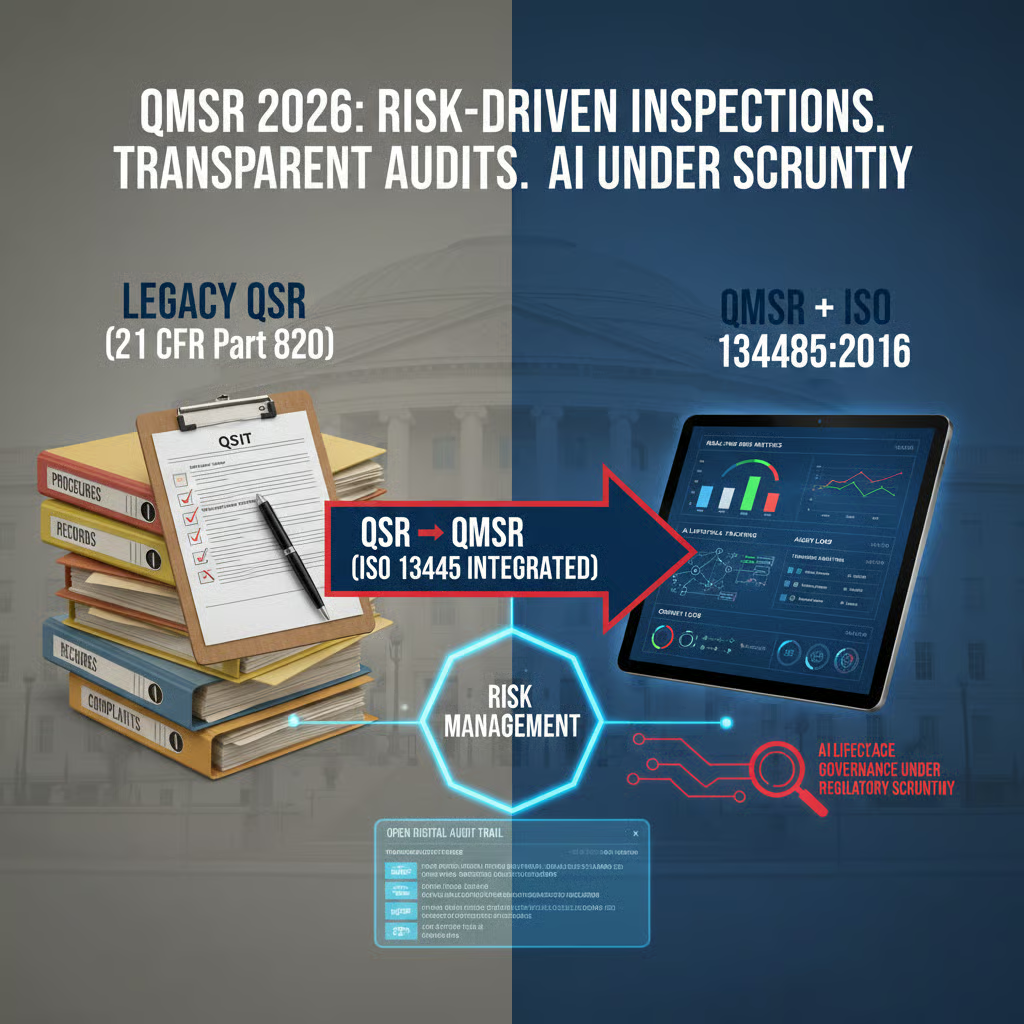
On February 2, 2026, the U.S. Food and Drug Administration (FDA) implemented the Quality Management System Regulation (QMSR), replacing the legacy Quality System Regulation (QSR) under 21 CFR Part 820.
By incorporating ISO 13485:2016 into federal law and retiring the QSIT inspection framework, the FDA introduced the most significant structural change to U.S. medical device oversight in decades.
The headline is not harmonization.

The headline is this:

Risk management now drives inspections. Audit documentation is no longer shielded. AI lifecycle governance is under regulatory scrutiny.
For pharmaceutical, biotech, and AI-enabled medical technology organizations in GxP environments, this fundamentally changes compliance operationalization.
2.0. What Changed Under QMSR: Risk Now Drives Inspections
The most significant transformation under QMSR is philosophical, not structural.
Under the former QSIT framework, FDA inspections focused on subsystems such as CAPA, Design Controls, Production & Process Controls, and Management Controls. Investigators followed structured sampling logic, evaluating compliance through documentation presence and adequacy.
Under QMSR, that paradigm shifted.
Inspections now organize around six broader QMS Areas, sampling tables are eliminated, and investigator discretion expanded. Most importantly, risk documentation determines inspection depth and direction (@ Allyson B. Mullen & @ Lisa M. Baumhardt., FDA Law Blog, Understanding FDA’s Risk-Based Inspection Model Under QMSR).
Investigators are instructed to:
- Use risk files to prioritize review areas
- Trace risk-based decisions across design, supplier management, change control, and postmarket surveillance
- Expand inspection scope if risk integration appears weak or fragmented
- Evaluate whether executive and management decisions demonstrate true risk-based governance
This shifts focus from documentation sufficiency to governance integrity.
The new Compliance Program Manual explicitly identifies risk management failures as grounds for Official Action Indicated (OAI) classifications, including:
- Failure to integrate postmarket surveillance data into risk management files
- Failure to evaluate design or software changes for risk impact
- Inadequate data analysis resulting in unmitigated health consequences
- Weak or superficial change control impact assessments
Risk management is no longer a static regulatory artifact maintained for audit readiness; it is a dynamic enforcement lever.
Under QMSR, the FDA assesses whether risk-based decisions are integrated, traceable, and actively govern the organization, not just whether a quality system exists.

3.0. QMSR Eliminates Audit Documentation Protection
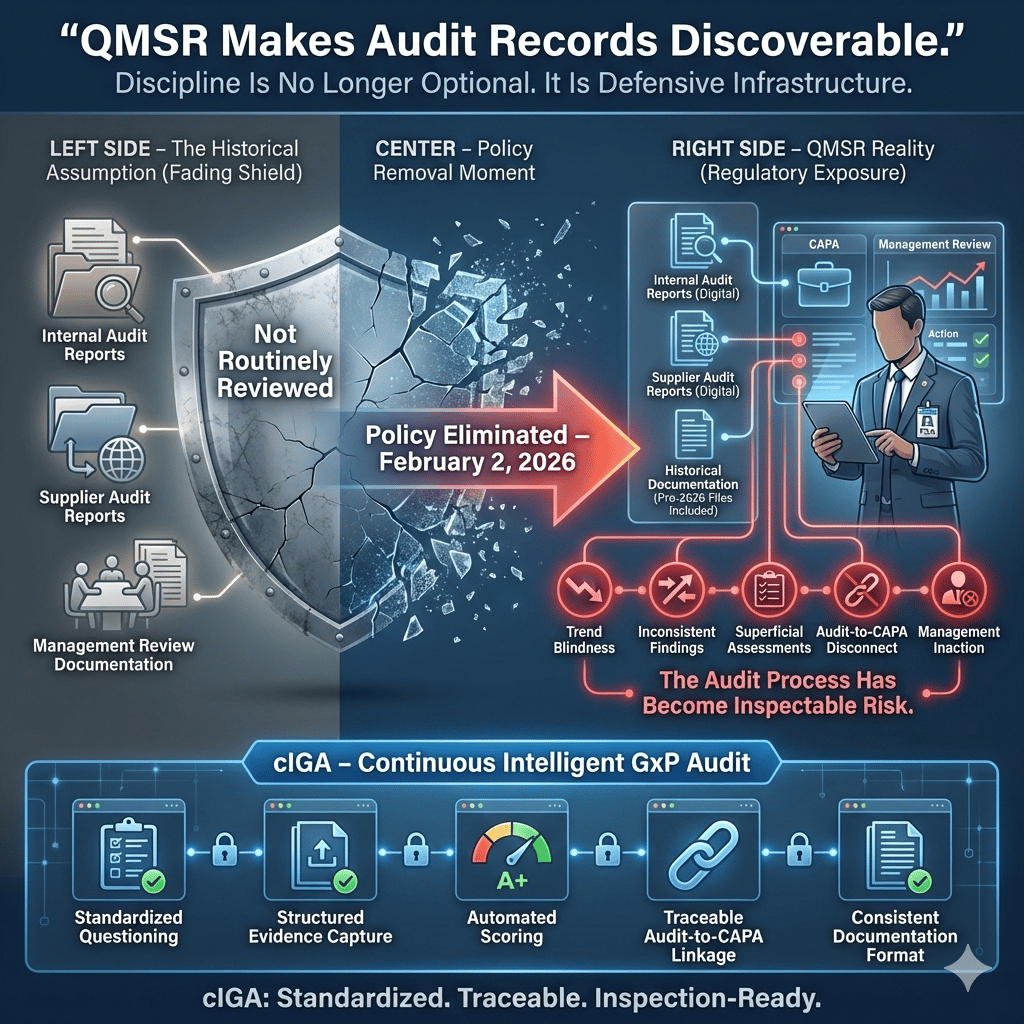
The most disruptive change under QMSR is the removal of FDA’s historical policy of not reviewing:
- Internal audit reports
- Supplier audit reports
- Management review documentation
That policy has been eliminated (@ Greg Matson, Preparing for QMSR in 2026).
Investigators may now request these records, including historical documentation generated before February 2, 2026.
What this means in practice
Many organizations historically treated internal audits as periodic exercises with narrative summaries that varied in quality across auditors and lacked standardization among suppliers.
Under QMSR, those audit records can now be scrutinized for
- Trend blindness
- Inconsistent findings
- Superficial assessments
- Disconnects between audit findings and CAPA
- Management inaction despite recurring signals
The audit process itself has become inspectable risk.
This is where cIGA becomes strategically critical.
4.0. How cIGA Supports QMSR Audit Governance
xLM’s Continuous Intelligent GxP Audit (cIGA) solution was designed for this compliance environment.
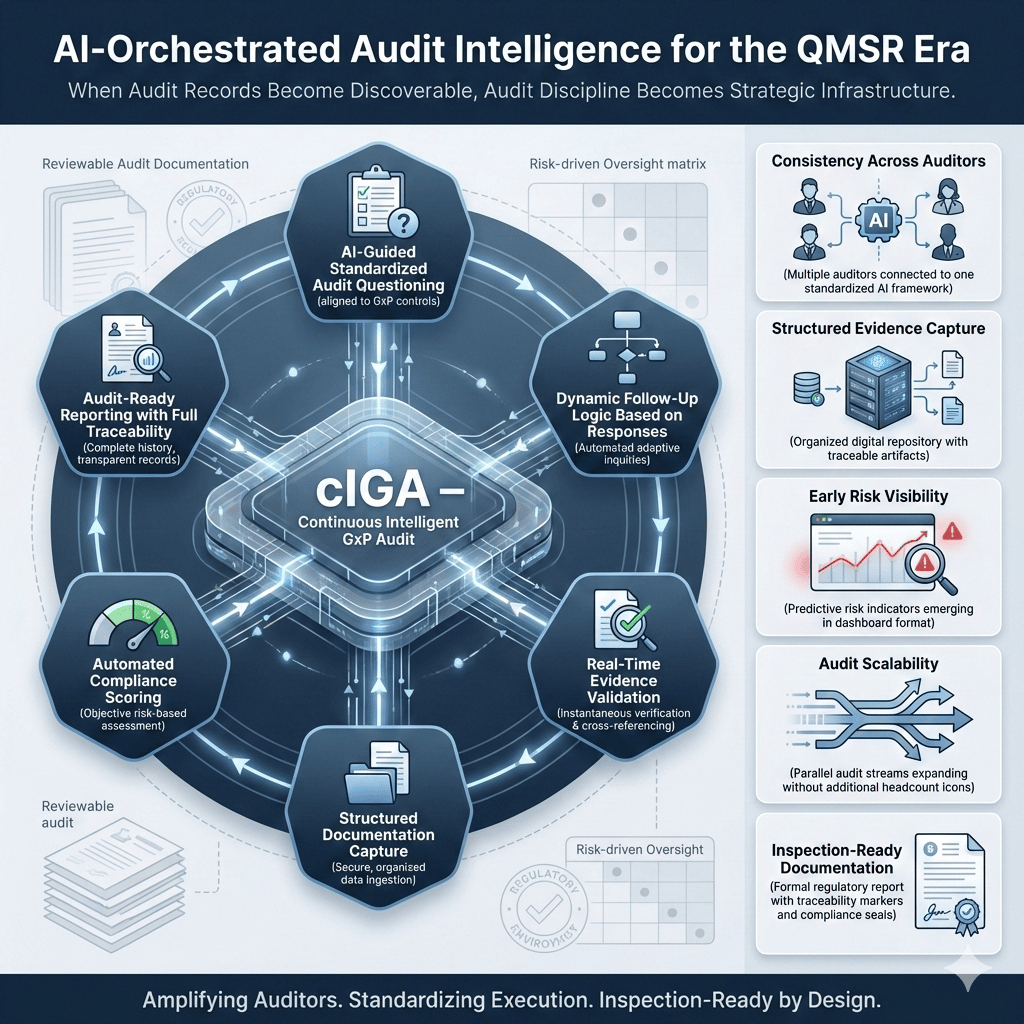
cIGA transforms audit execution from episodic documentation into structured, AI-orchestrated intelligence.
What cIGA enables:
- AI-guided, standardized audit questioning aligned to GxP controls
- Dynamic follow-up based on responses
- Real-time validation of evidence
- Structured documentation capture
- Automated compliance scoring
- Complete audit-ready reporting with traceability
In a QMSR environment where audit documentation is reviewable, cIGA delivers:
- Consistency across auditors - Eliminates variability in question framing, interpretation, and documentation.
- Structured evidence capture - Ensures auditee responses and artifacts are traceable and organized.
- Early risk visibility - AI-assisted scoring identifies emerging risk signals before escalation.
- Audit scalability - Enables parallel supplier audits without increasing headcount.
- Inspection-ready documentation - Produces defensible, standardized reports that withstand regulatory scrutiny.
When audit records become discoverable, audit discipline becomes strategic infrastructure.
cIGA does not replace auditors; it amplifies, standardizes, and makes their work inspection-ready by design (@xLM Continuous Intelligence, AI in GxP Manufacturing, Reengineering Vendor Audits for the AI Era).
5.0. AI Systems Under QMSR: Continuous Validation Required
QMSR’s elevation of lifecycle risk management is especially consequential for AI-enabled systems.
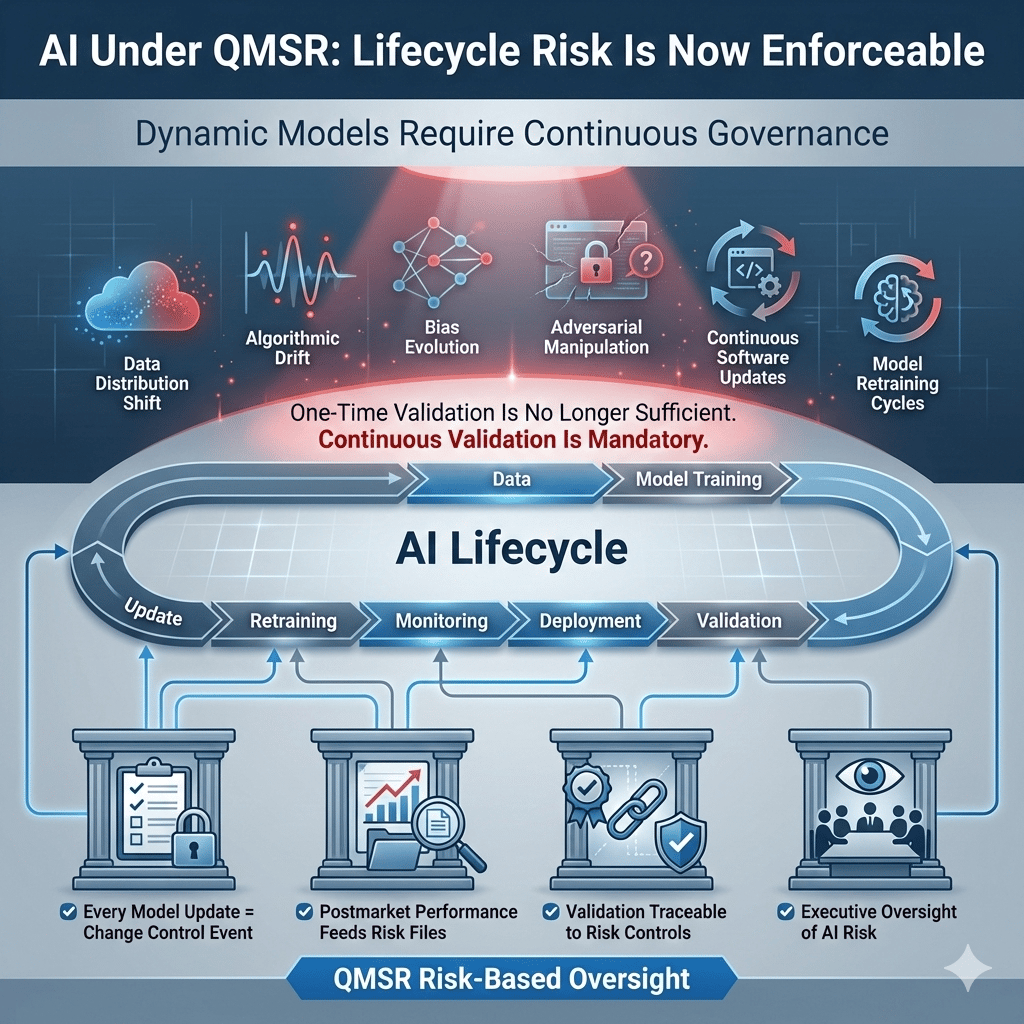
AI introduces dynamic risk variables:
- Algorithmic drift
- Model retraining cycles
- Data distribution shifts
- Bias evolution
- Adversarial manipulation risk
- Continuous software updates
Under QMSR:
- Every model update is a change control event
- Postmarket performance must feed into risk management
- Validation must trace to risk controls
- Management must demonstrate oversight of AI risk
One-time validation is insufficient. AI requires continuous validation.
6.0. How cIV Operationalizes AI Risk Governance
xLM’s Continuous Intelligent Validation (cIV) platform embeds validation into the AI lifecycle.
cIV enables:
- AI-assisted generation of User Requirements Specifications (URS)
- Automated generation of test cases aligned to risk controls
- Two-way traceability matrices
- Automated test execution and evidence capture
- Structured logs, screenshots, and validation artifacts
- Continuous re-validation following AI model updates
In a QMSR context, cIV supports:
- Drift validation - Testing model performance against predefined thresholds after retraining.
- Bias monitoring - Validating outputs across demographic or use-case variations.
- Change impact analysis - Documenting how updates affect risk controls.
- PCCP support - Operationalizing Predetermined Change Control Plans through controlled validation workflows.
- Audit-ready documentation - Maintaining structured validation evidence for FDA inspection or Remote Regulatory Assessment (RRA).
Where QMSR requires lifecycle risk governance, cIV provides the execution layer (@xLM Continuous Intelligence, AI in GxP Manufacturing, Continuous Intelligent Validation (cIV): From Months of Manual Validation to Minutes of Intelligent Execution).

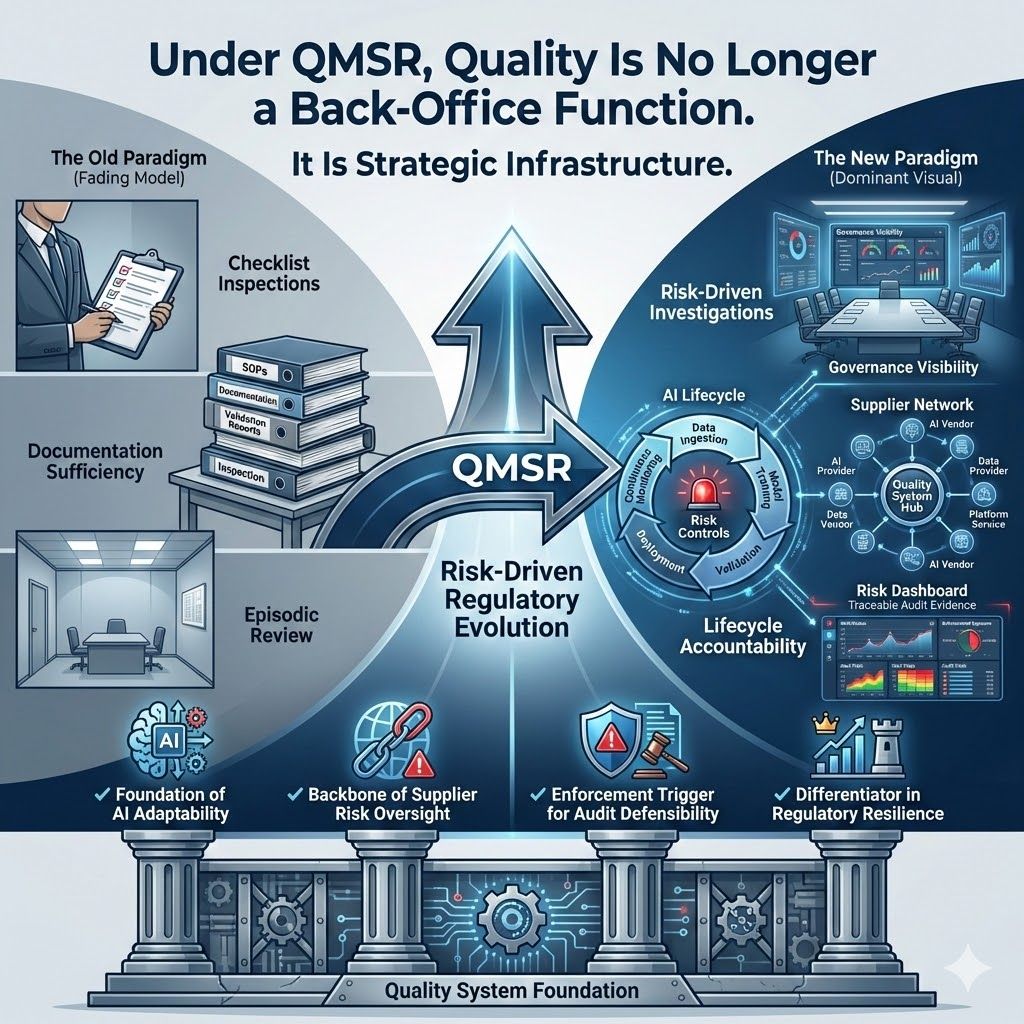
7.0. The Bigger Shift: From Compliance to Continuous Governance
QMSR signals a regulatory evolution:
- From checklist inspections to risk-driven investigations
- From documentation sufficiency to governance integrity
- From episodic review to lifecycle accountability
For pharma companies deploying AI-enabled systems and managing complex vendor ecosystems, the quality system is no longer a back-office function.
It is:
- The foundation of AI adaptability
- The backbone of supplier risk oversight
- The enforcement trigger for audit defensibility
- The differentiator in regulatory resilience
8.0. Final Thoughts: cIGA + cIV in a QMSR World
QMSR is not about more paperwork. It is about integrated governance.
cIGA addresses governance at the supplier and internal audit level. cIV addresses governance at the AI model and validation lifecycle level.
Together, they create:
- Structured audit intelligence
- Continuous validation traceability
- Closed-loop risk integration
- Scalable compliance execution
- Executive visibility into quality signals
This aligns directly with QMSR’s emphasis on:
- Risk-based inspection
- Management accountability
- Data-driven oversight
- Continuous improvement
9.0. Related Articles
- #093: Continuous Intelligent Validation: Faster GxP Execution
- #091: Reengineering GxP Vendor Audits for the AI Era
- #080: Rethinking Work in the Age of AI with Continuous cIV
- #065: Transform Validation with Continuous Intelligent Validation
- #046: Continuous Intelligent Validation (cIV) for Software Testing
share this