
FDA's New AI Guidance and Continuous AI Credibility
Discover how FDA AI guidance is driving continuous AI credibility, governance, validation, and compliance across GxP manufacturing operations.

share this

1.0. Why Trust Will Define the Future of AI in Pharmaceutical Manufacturing
Artificial Intelligence (AI) is rapidly integrating into pharmaceutical operations. From predictive maintenance and environmental monitoring to validation, quality oversight, and manufacturing intelligence, AI increasingly influences decisions affecting product quality, patient safety, and regulatory compliance. While recent focus has been on AI's capabilities, the FDA's draft guidance shifts the conversation to:
How can organizations continuously demonstrate that AI-generated decisions can be trusted?The FDA's draft guidance, "Considerations for the Use of Artificial Intelligence to Support Regulatory Decision-Making for Drug and Biological Products," marks a milestone in evolving AI governance for regulated industries. Though it covers the entire drug lifecycle, its impact on pharmaceutical manufacturing and GxP operations is profound.
At its core, the guidance introduces a concept likely to shape AI adoption in regulated environments.
The FDA states organizations must establish confidence in AI outputs based on their intended use and the risk associated with the decisions they support. Deploying AI alone is insufficient; companies must demonstrate why a model is trustworthy, how it was developed, monitored, and maintained.
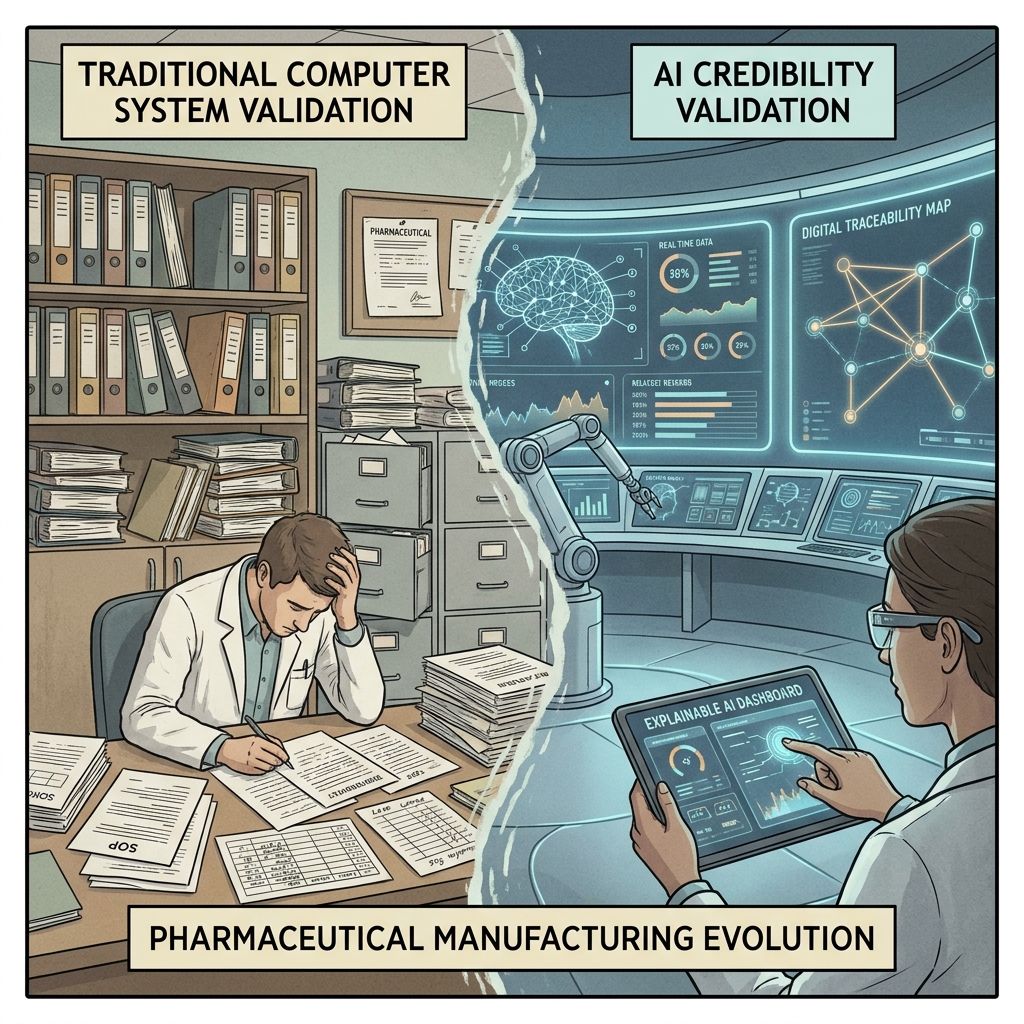
The industry is witnessing the emergence of a new paradigm where compliance is no longer focused solely on validating systems. It is increasingly focused on validating the credibility of intelligence

2.0. From system validation to intelligence validation
Pharmaceutical manufacturers have long used validation to prove computerized systems perform as intended. AI introduces a new challenge: unlike traditional software with fixed logic, AI models learn from data, adapt, and often produce probabilistic outputs.
The guidance highlights concerns about data quality, representativeness, transparency, uncertainty, bias, and model drift. Together, these show that AI systems performing well today may not do so tomorrow.
Hence, the FDA stresses the need for a Risk-Based Credibility Assessment Framework. The guidance signals a shift from validating software to validating intelligence
As AI spreads in manufacturing, organizations must answer:
"What evidence shows this AI model suits its intended purpose?"
"How is model performance monitored post-deployment?"
"What controls exist when conditions change?"
"How do we know the model remains credible six months from now?"
These extend beyond traditional validation toward a Continuous AI Governance Model.
3.0. Why FDA AI Guidance Matters for GxP Manufacturing
The FDA shows AI's growing role in manufacturing. Applications like automated visual inspection, process optimization, predictive analytics, environmental monitoring, quality investigations, and manufacturing process control can influence product quality decisions.
The agency introduces a framework based on Model Influence and Decision Consequence. Simply put, the greater an AI model's influence and the higher the impact of a wrong decision, the stricter the regulatory expectations.
For manufacturers, AI Governance must evolve from isolated validation to a structured model managing AI Risk across use cases.
Credibility must be proportional to risk
4.0. The Emergence of Continuous AI Credibility
The guidance recognizes AI performance is dynamic. The FDA addresses concerns about data drift, changing deployment environments, evolving datasets, retraining, and ongoing model maintenance. It stresses continuous oversight throughout the model lifecycle.
Manufacturing evolves: processes change, equipment ages, suppliers shift, portfolios grow, and data increases. AI systems must prove they remain fit for purpose. AI governance's future depends on continuous monitoring, continuous validation, and continuous evidence generation.
AI credibility is not a one-time event. It is a lifecycle responsibility
For organizations scaling AI in GxP, this is the guidance's key message.

5.0. ContinuousOS: An Operating System for Governed AI in GxP Operations
The FDA's principles reflect challenges many pharmaceutical firms face. While single AI applications add value, managing many AI-driven processes across manufacturing, quality, validation, and compliance needs a unified model.
This challenge inspired ContinuousOS. ContinuousOS is an AI-native operating environment for GxP operations where intelligence, compliance, governance, and execution coexist within one framework.
Instead of isolated AI tools, ContinuousOS organizes AI around governed operational workflows with specialized AI agents supporting validation, environmental monitoring, predictive maintenance, vendor auditing, compliance assessments, quality investigations, and operational decision support.
Central to ContinuousOS is Continuous Validation, Continuous Compliance, Continuous Monitoring, and Continuous Intelligence. Each AI action generates traceable evidence, maintains transparency, and builds a compliance knowledge base supporting operational excellence and readiness.
Each AI agent operates within a defined Context of Use (COU) and follows governance controls. Evidence, outcomes, risk assessments, audit trails, and approvals link continuously to processes, creating a transparent environment.

6.0. Building AI Governance into Daily Operations
A key FDA point is Context of Use (COU). AI credibility must be judged by the model's specific decision role.
ContinuousOS follows this principle. Each AI agent works within defined boundaries, supported by workflows, human oversight, and traceable evidence generation. Rather than a black box, the platform reveals how conclusions form, evidence collects, and decisions review.
This creates a framework where AI is a managed participant in the Pharmaceutical Quality System instead of an uncontrolled external tool.

7.0. Continuous Validation for Continuous Intelligence
Validation has focused on systems and processes. As AI enters decision-making, organizations must validate the intelligence those systems produce. ContinuousOS meets this with Continuous Validation, Continuous Compliance, and Lifecycle AI Governance.
Operational data, AI evidence, audit trails, performance metrics, monitoring, and workflow outcomes remain linked throughout the lifecycle. This lets organizations continuously assess AI's alignment with its purpose. This supports the FDA's focus on lifecycle maintenance, model performance monitoring, and ongoing credibility assessments.
Instead of periodic reviews, organizations gain continuous visibility into AI effectiveness and behavior.

8.0. Preparing for the Future of AI-Regulated Manufacturing
The FDA's draft guidance does not hinder AI adoption in pharmaceutical manufacturing. It clarifies the path for broader use. It recognizes AI's transformative potential while setting expectations for governance, transparency, risk management, and lifecycle oversight.
The future favors organizations combining Intelligent Automation with Continuous Credibility. As AI embeds across validation, quality, compliance, maintenance, and manufacturing, success depends not just on algorithms but on demonstrating trustworthiness, transparency, and control.
The next chapter of digital transformation in pharma will not be defined by how much AI organizations deploy. It will be defined by how effectively they govern it
9.0. About the Authors
Nagesh Nama
CEO, xLM Continuous Intelligence | Founder, ValiMation
Nagesh is a pioneer in AI/ML-driven GxP compliance with nearly three decades of experience helping pharmaceutical, biotech, and medical device companies navigate validation, data integrity, and regulatory compliance. He is the founder and CEO of both ValiMation (founded 1996) and xLM Continuous Intelligence — the company that first introduced a Continuous Validation platform supporting IaaS/PaaS/SaaS environments compliant with 21 CFR Part 11 and Annex 11. Today, xLM offers a comprehensive suite of continuously validated AI/ML managed services spanning intelligent validation (cIV), predictive maintenance, temperature mapping, and GxP AI agents. Nagesh is a member of the Forbes Technology Council and the Fast Company Executive Board, a contributor to Forbes and Fast Company, and has been featured on Microsoft's AI Agents Vlog. He holds an M.S. in Manufacturing Engineering from the University of Massachusetts, Amherst.
Mansi Joshi
Project Manager, AI Validation & QA Automation | xLM Continuous Intelligence
Mansi Joshi is a Project Manager at xLM, where she leads the delivery of AI-driven validation and automation quality assurance managed services for pharmaceutical, biotechnology, and medical device organizations. She specializes in managing validation lifecycles for On-Premise and Cloud-based GxP applications, including qualification for AWS, Microsoft Azure, and Google Cloud platforms, while ensuring quality SLAs, regulatory compliance, and continuous improvement across validation programs. Leveraging xLM’s Continuous Validation capabilities, Mansi works closely with cross-functional teams to drive risk-based validation strategies, support client transitions from CSV to CSA, strengthen data integrity programs, and enable intelligent automation adoption that helps organizations achieve faster compliance, operational efficiency, and sustainable quality transformation.
Kashyap Joshi
Program Manager, AI/ML ContinuousOS Apps | xLM Continuous Intelligence
Kashyap Joshi is a Program Manager at xLM, where he leads the implementation of complex AI systems for life sciences organizations by aligning stringent GxP regulatory requirements with next‑generation technology and xLM’s ContinuousOS Suite of Apps to deliver measurable ROI, continuous compliance, and long‑term transformation for clients across pharma, biotech, and medical devices.
share this