
Digital Twins for Autonomous Pharmaceutical Manufacturing
Discover how digital twins and Continuous Operational Intelligence enable autonomous manufacturing, GxP compliance, AI orchestration, and Pharma 4.0 success.

share this
1.0. Introduction
For over a decade, digital twins have been a transformative technology in pharmaceutical and life sciences manufacturing. Organizations have invested heavily in creating digital replicas of assets, facilities, processes, equipment, and supply chains. These virtual models promised unprecedented visibility, predictive insights, and operational optimization.
They have delivered.
Digital twins enable manufacturers to anticipate equipment failures, simulate process changes, optimize facility use, and improve product quality through advanced modeling and analytics. They form a foundation for Industry 4.0 and Pharma 4.0 strategies, helping organizations shift from reactive operations to intelligent, data-driven decision-making.
Despite these successes, the industry realizes digital twins excel at representing reality, but representation alone is insufficient. The next step is understanding how digital intelligence can actively shape operational outcomes in real time.
This raises a key question:
If digital twins mirror the enterprise so well, what enables them to move from observation to action?
2.0. The Evolution of Digital Twins
Digital twins have progressed through three phases, expanding their role from passive visibility to active operational intelligence.
2.1. Phase 1: Visualization and Monitoring
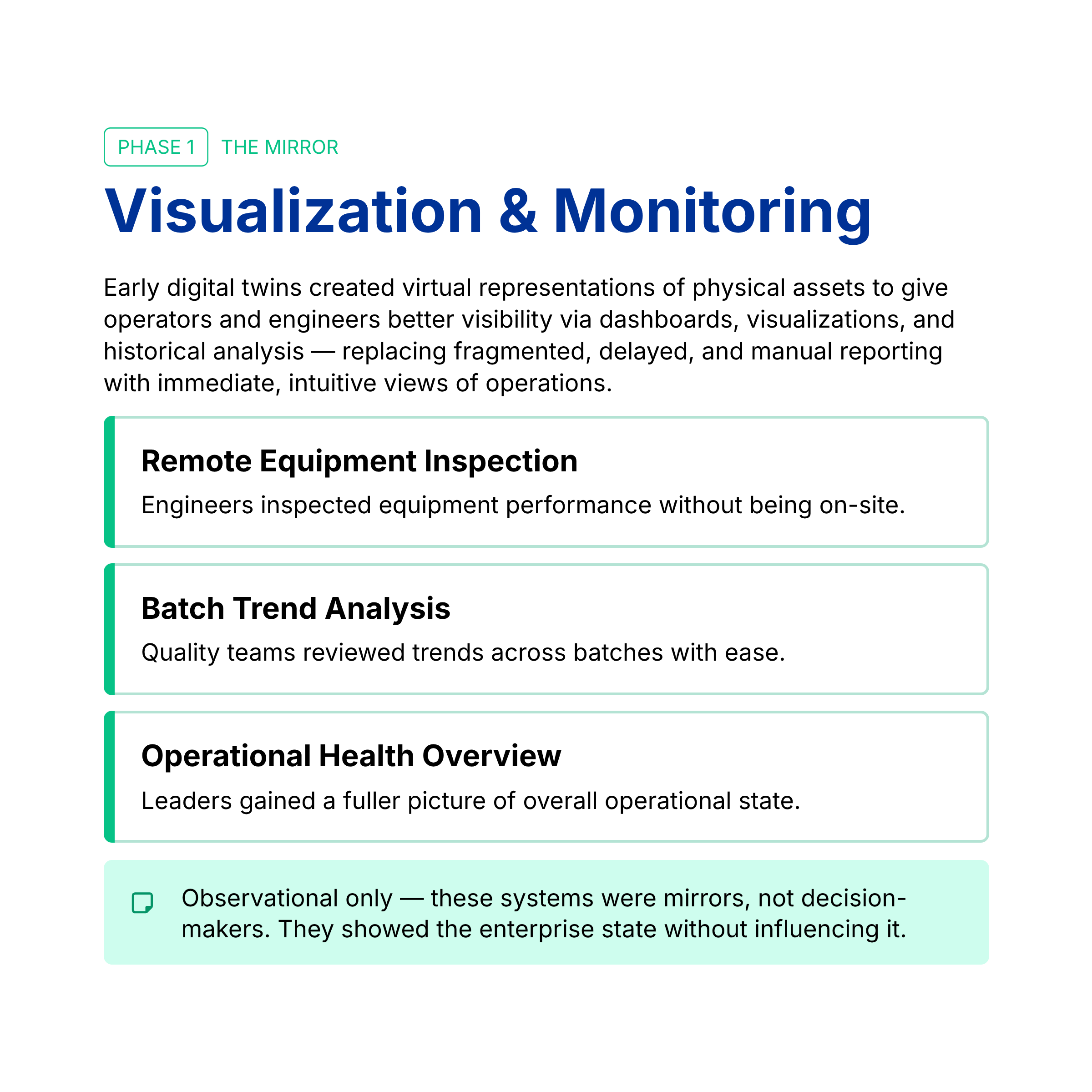
Early digital twins created virtual representations of physical assets to give operators and engineers better visibility via dashboards, visualizations, and historical analysis. These systems helped teams understand what was happening on the shop floor, where, and how the organization reached a state.
This first generation replaced fragmented, delayed, and manual reporting with immediate, intuitive views of operations. Engineers inspected equipment performance remotely. Quality teams reviewed trends across batches. Leaders gained a fuller picture of operational health.
However, these systems remained observational. They were mirrors, not decision-makers. They showed the enterprise state without influencing it.
2.2. Phase 2: Prediction and Simulation
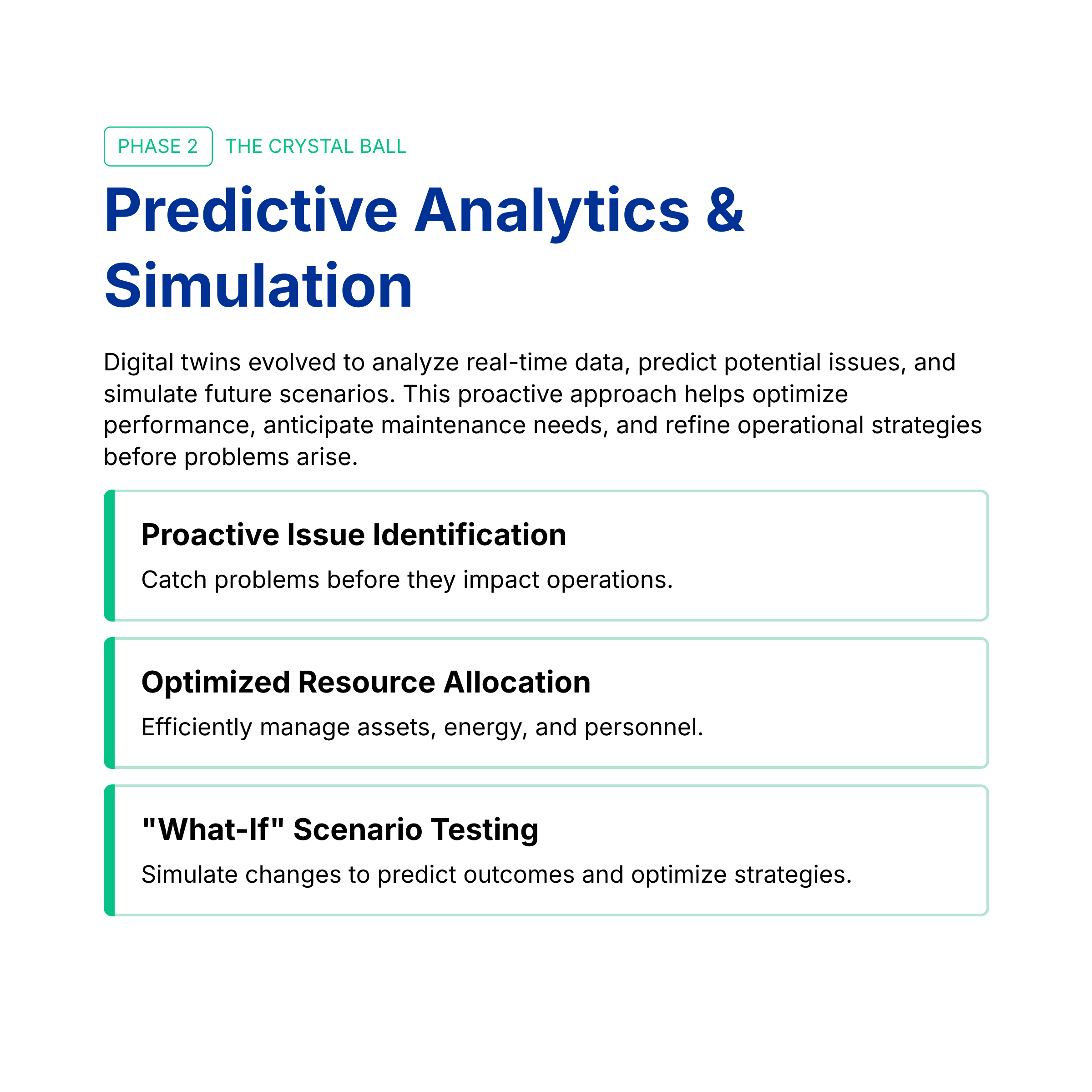
As AI and machine learning advanced, digital twins evolved into predictive systems forecasting operational outcomes. The twin no longer just reflected the present; it anticipated the future.
Organizations used digital twins to predict equipment failures, simulate scenarios, optimize processes, forecast quality deviations, and improve maintenance. These capabilities transformed reliability, process development, and planning. Manufacturers could intervene earlier with confidence.
This phase made digital twins powerful decision-support tools. They answered what might happen, what risks could emerge, and what actions to consider. For pharmaceutical manufacturers, this predictive ability supports better control over complex, regulated processes where variability matters.
Still, digital twins remained advisory. They forecasted and recommended but did not orchestrate broader operational responses in regulated environments.
2.3. Phase 3: Autonomous Operations
The industry now enters a third, most consequential phase. The question is no longer if digital twins can predict outcomes but if they can participate directly in operations.
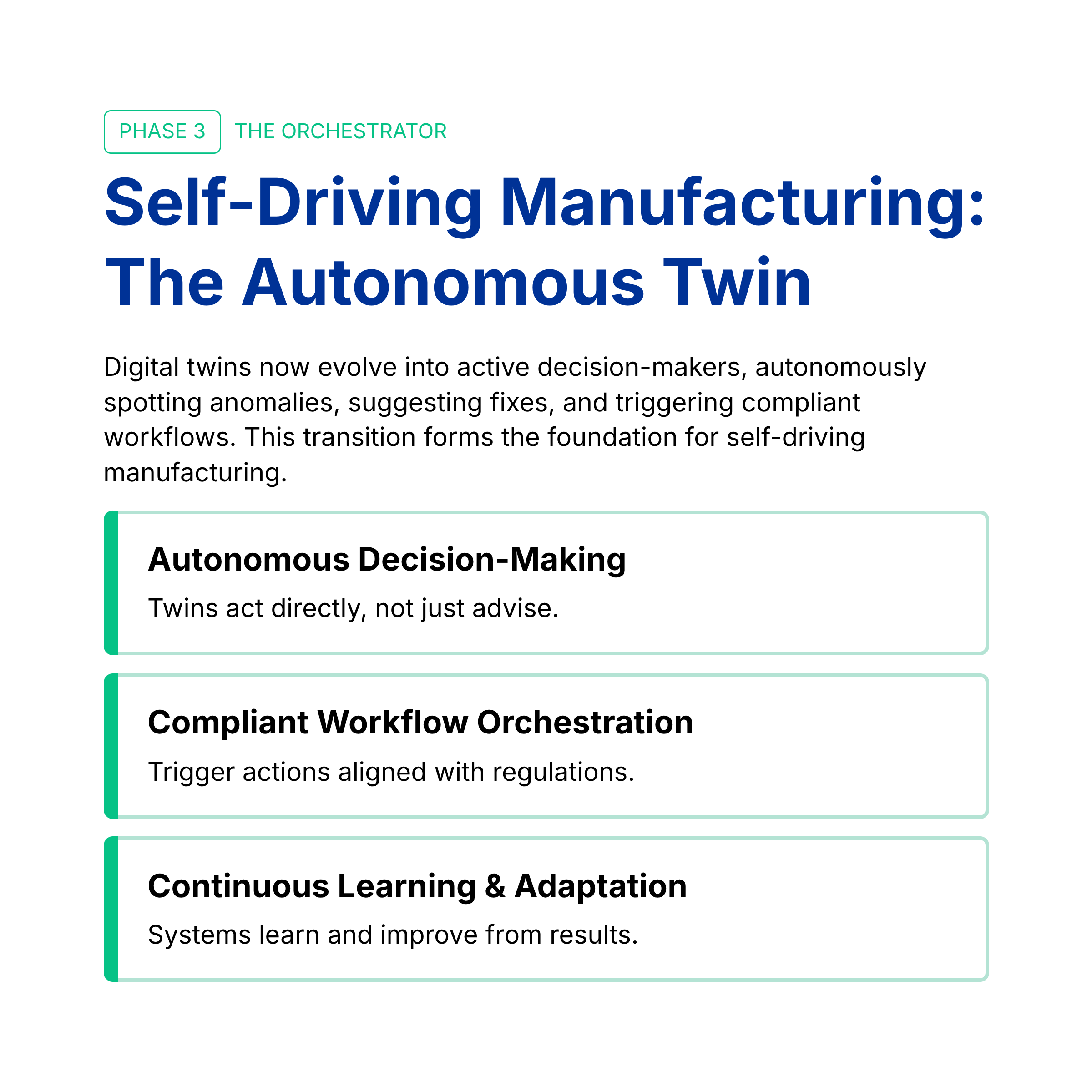
Digital twins must spot anomalies, assess business and compliance impacts, suggest fixes, trigger workflows, coordinate with systems, and learn from results. More importantly, they must resolve issues traceably and compliantly, aligned with priorities. This is self-driving manufacturing, where digital twins shift from passive models to active decision-makers.
This transition forms the foundation of self-driving manufacturing. The digital twin becomes part of an operational intelligence ecosystem that senses, reasons, decides, and acts.
3.0. The Execution Gap in Digital Twin Architectures
Despite advances, many organizations find digital twins alone cannot deliver autonomous manufacturing. The issue is not their effectiveness; they are accurate and informative. The challenge is intelligence and execution differ.
Digital twins observe, simulate, and predict, vital for understanding operations. But autonomous manufacturing needs systems that reason contextually, coordinate functions, include compliance, make risk-based decisions, learn from results, enable human-machine teamwork, and run workflows autonomously. These form the base for intelligent, self-driving manufacturing.
This creates a key challenge in digital transformation: the gap between intelligence and action.
Consider a predictive maintenance twin forecasting compressor failure in a sterile facility. It identifies the issue and estimates time to failure. That insight is valuable but only the start. The organization must decide whether to schedule maintenance immediately, reschedule production, assess validated state impact, issue quality notifications, initiate deviations, update risk assessments, or adjust environmental monitoring.
The twin alone cannot answer these because answers depend on quality, operations, compliance, maintenance, and business continuity context. An operational intelligence layer must understand manufacturing context, regulatory requirements, business priorities, and constraints simultaneously. Without this layer, even advanced digital twins remain stuck in insight without execution.
4.0. The Rise of Continuous Operational Intelligence
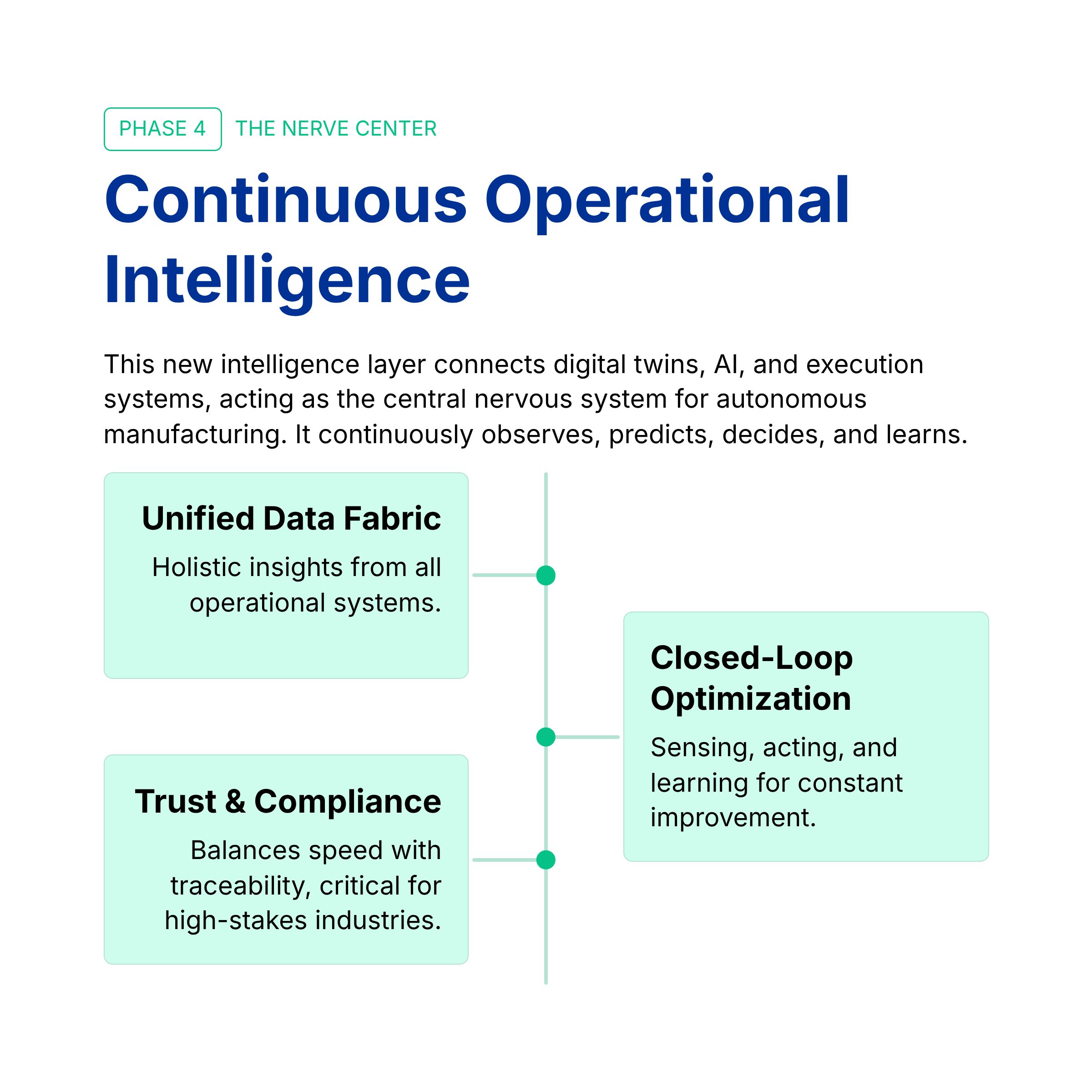
As pharmaceutical manufacturing advances toward autonomy, a new architecture emerges. Instead of standalone digital twins, organizations see the need for a continuous operational intelligence framework connecting digital twins, execution systems, quality management, validation, asset management, environmental monitoring, predictive analytics, and AI agents into a unified fabric.
This intelligence layer acts like the central nervous system of an autonomous enterprise. It continuously observes, interprets, predicts, decides, executes, learns, and optimizes, closing the loop between sensing and action.
Within this architecture, digital twins evolve from static reflections into active operational participants. They ingest data from multiple sources, reason across functions, and initiate responses that are operationally effective and regulatory compliant.
This is crucial in life sciences, where stakes are high and tolerance for error is low. Autonomous operations must balance speed with traceability, governance, and trust. Continuous operational intelligence provides this structure.
5.0. From Predictive Manufacturing to Self-Driving Manufacturing
The future of pharmaceutical manufacturing depends not just on advanced AI or digital twins but on orchestrating intelligence continuously across the enterprise.
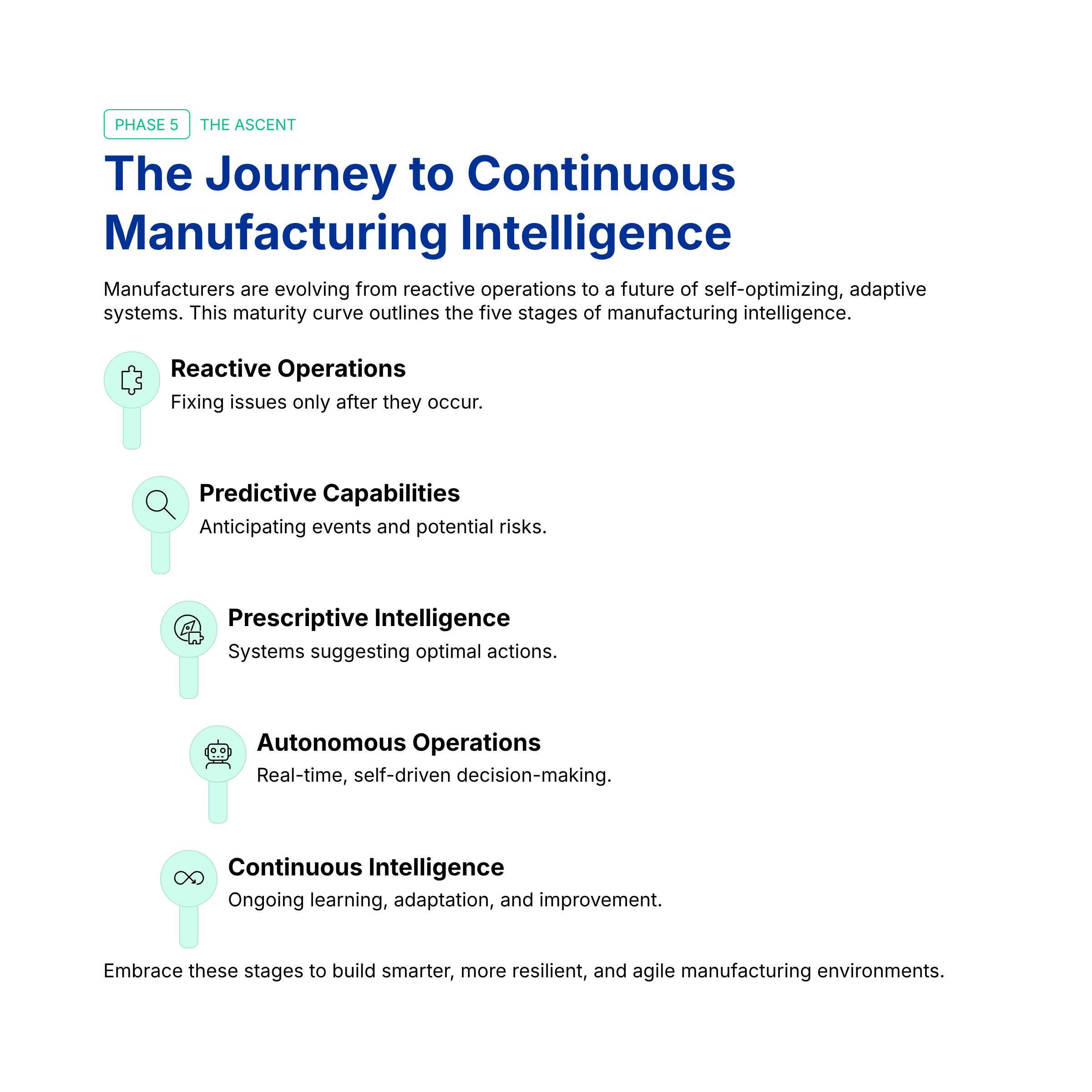
This maturity curve shows how manufacturing intelligence evolves. Organizations start with reactive operations, fixing issues after they happen, then move to predictive capabilities to foresee events and risks. Next is prescriptive intelligence, where systems suggest best actions based on predictions. Further progress leads to autonomous operations, with real-time decision-making and optimization. Finally, continuous manufacturing intelligence emerges, where each cycle drives ongoing learning, adaptation, and improvement.
This maturity curve is more than a concept; it reflects the industry's direction as organizations seek to reduce downtime, improve quality, strengthen compliance, and increase agility in complex environments.
Organizations that move beyond predictive analytics to continuous operational intelligence will gain competitive advantages. They will better manage variability, respond to disruptions, maintain validated states, and make faster, confident decisions. They will create manufacturing environments that are smarter, resilient, and adaptive.
6.0. Beyond Digital Twins: Building the Operating System for Autonomous Manufacturing
As pharmaceutical and life sciences organizations pursue self-driving manufacturing, the focus shifts from digital twins alone to intelligence frameworks enabling autonomy. Digital twins remain essential but are part of a larger transformation toward continuously intelligent operations.
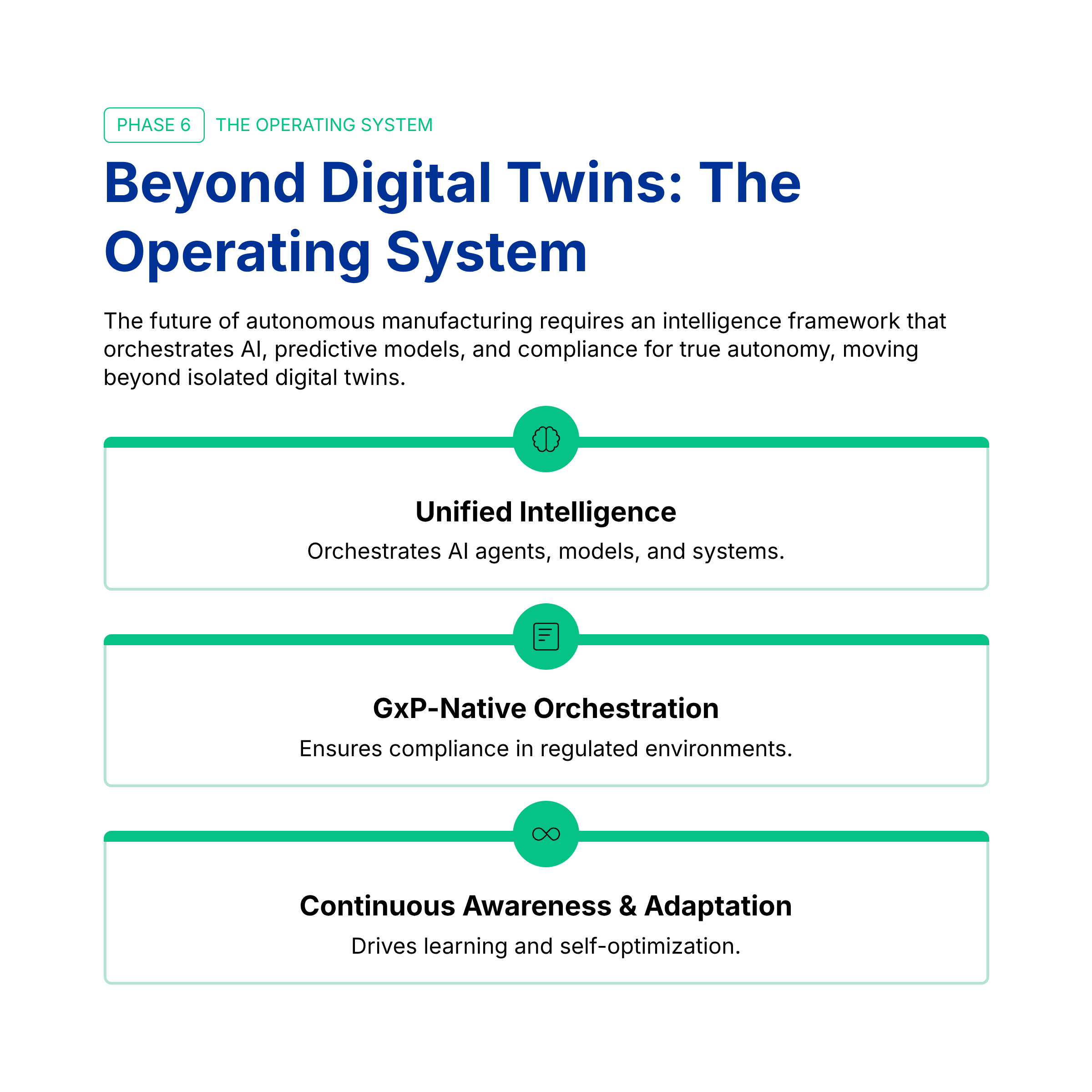
At xLM - Continuous Intelligence, we believe realizing digital twins' full value requires an operational layer orchestrating AI agents, predictive models, compliance workflows, manufacturing systems, and human expertise into a unified ecosystem. In regulated environments, this orchestration is essential. It distinguishes isolated intelligence from enterprise-wide transformation.
This philosophy shapes our vision for ContinuousOS, a continuous operational intelligence framework designed for regulated life sciences. ContinuousOS bridges digital representation and operational execution by combining continuous intelligence, autonomous agents, predictive analytics, human-in-the-loop governance, and GxP-native orchestration. The goal is not just automation but continuous awareness, adaptation, and alignment with quality and compliance.
This distinction matters because the future of autonomous manufacturing will not be won by those with the most data alone but by those turning data into coordinated action and action into institutional learning.
Digital twins may become the enterprise's eyes and hands, offering unprecedented visibility and responsiveness. But leaders will build intelligence systems enabling those twins to continuously think, learn, and act.
Thus, the next manufacturing era will be defined not by the mirror itself but by the operating system behind it.
7.0. About the Authors
Nagesh Nama
CEO, xLM Continuous Intelligence | Founder, ValiMation
Nagesh is a pioneer in AI/ML-driven GxP compliance with nearly three decades of experience helping pharmaceutical, biotech, and medical device companies navigate validation, data integrity, and regulatory compliance. He is the founder and CEO of both ValiMation (founded 1996) and xLM Continuous Intelligence — the company that first introduced a Continuous Validation platform supporting IaaS/PaaS/SaaS environments compliant with 21 CFR Part 11 and Annex 11. Today, xLM offers a comprehensive suite of continuously validated AI/ML managed services spanning intelligent validation (cIV), predictive maintenance, temperature mapping, and GxP AI agents. Nagesh is a member of the Forbes Technology Council and the Fast Company Executive Board, a contributor to Forbes and Fast Company, and has been featured on Microsoft's AI Agents Vlog. He holds an M.S. in Manufacturing Engineering from the University of Massachusetts, Amherst.
Mansi Joshi
Project Manager, AI Validation & QA Automation | xLM Continuous Intelligence
Mansi Joshi is a Project Manager at xLM, where she leads the delivery of AI-driven validation and automation quality assurance managed services for pharmaceutical, biotechnology, and medical device organizations. She specializes in managing validation lifecycles for On-Premise and Cloud-based GxP applications, including qualification for AWS, Microsoft Azure, and Google Cloud platforms, while ensuring quality SLAs, regulatory compliance, and continuous improvement across validation programs. Leveraging xLM’s Continuous Validation capabilities, Mansi works closely with cross-functional teams to drive risk-based validation strategies, support client transitions from CSV to CSA, strengthen data integrity programs, and enable intelligent automation adoption that helps organizations achieve faster compliance, operational efficiency, and sustainable quality transformation.
Kashyap Joshi
Program Manager, AI/ML ContinuousOS Apps | xLM Continuous Intelligence
Kashyap Joshi is a Program Manager at xLM, where he leads the implementation of complex AI systems for life sciences organizations by aligning stringent GxP regulatory requirements with next‑generation technology and xLM’s ContinuousOS Suite of Apps to deliver measurable ROI, continuous compliance, and long‑term transformation for clients across pharma, biotech, and medical devices.
share this