
AI in Biologics Manufacturing: xLM LinkedIn Live Insights
Discover AI in biologics manufacturing insights from xLM LinkedIn Live, exploring AI decision support, GxP compliance, knowledge retention, and innovation.

share this
1.0. Introduction: How AI Is Transforming Biologics Manufacturing
The future of biologics new facility construction will not be built by AI alone, but it will almost certainly be built by organizations that know how to combine human expertise with intelligent AI systems.
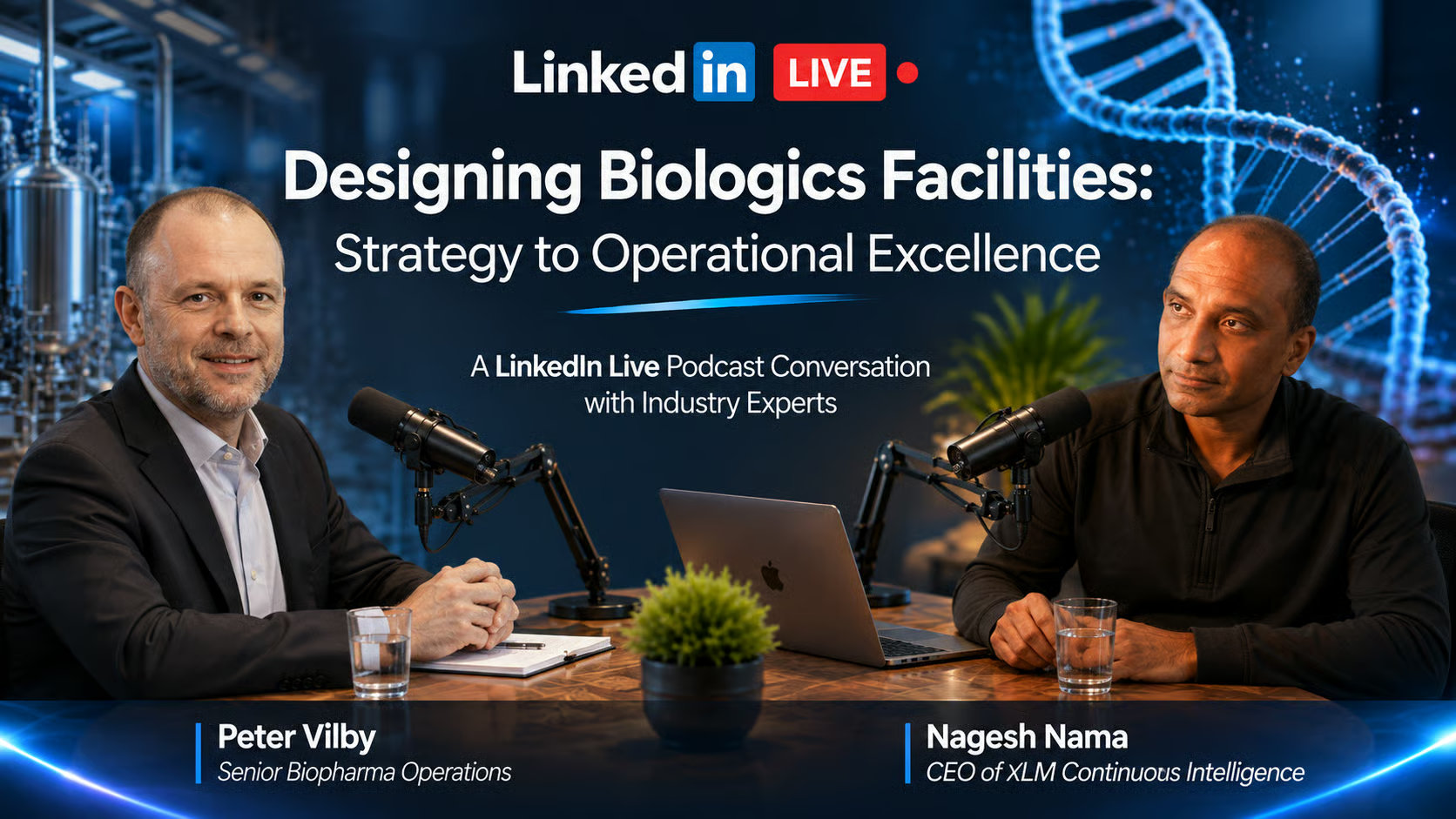
That was the central theme of our recent LinkedIn Live session, where Peter Vilby, a globally respected biologics manufacturing leader with more than two decades of experience delivering large-scale pharmaceutical facilities, joined Nagesh Nama, CEO of xLM Continuous Intelligence, for an engaging discussion on how AI is transforming the planning, design, validation, and operation of biotech manufacturing facilities.
The discussion attracted significant interest from professionals across the global life sciences community. The LinkedIn Live session received 132 registrations, generated 223 video views, and accumulated 1,765 total minutes viewed. The strong registration numbers, sustained viewing time, and live participation reflected the growing interest in how AI can be applied responsibly to engineering, validation, quality, and biologics new facility construction.
The conversation made one point abundantly clear.
AI empowers biotech experts with faster insights and preserved knowledge without replacing human judgement.
2.0. AI as a Co-Pilot for Expert Decisions in Biologics Manufacturing
Peter Vilby emphasised that AI will never replace experts, the responsibility for critical decisions will always remain with the people designing and operating facilities. Instead, AI should serve as an intelligent co-pilot, capable of retrieving the right information in seconds, complete with citations and source traceability.
Its real value lies in helping engineers, quality teams, and project leaders access design standards, regulatory requirements, project history, and lessons learned without relying on memory. Even more importantly, AI can transform deviations, near misses, and lessons learned from one facility into searchable, reusable intelligence for future projects, ensuring valuable knowledge is never lost.
3.0. AI for Corporate Policy and Regulatory Compliance
Imagine submitting an engineering design to a validated AI system that instantly checks whether it complies with corporate policies, SOPs, FDA regulations, and EMA requirements. The system highlights gaps, explains its findings, and provides direct citations to the relevant policies and standards.
Since no individual expert can master every discipline, from software validation and engineering to water systems and microbiology, AI acts as a cross-functional compliance advisor, enabling faster, more consistent reviews while leaving final decisions with qualified experts.
4.0. Could AI Become a Future cGMP Requirement?
A thought-provoking discussion explored whether AI could eventually become as essential to biologics manufacturing as digital quality systems are today.
Peter noted that cGMP evolves alongside technologies that demonstrably improve product quality and patient safety. If AI consistently enables better deviation assessments, reduces risk, and improves decision-making, regulators may increasingly expect organizations to explain and eventually standardize how AI is used throughout the project lifecycle.
5.0. Preserving Knowledge Across Long Capital Projects
Biologics capital programs often span three to five years or more, during which countless design decisions, expert discussions, and engineering reviews take place. As projects evolve and teams change, much of this valuable knowledge is often lost.
AI can capture subject matter expert (SME) knowledge preserve project context, and keep teams aligned through every design review and project milestone. By maintaining a searchable record of decisions and their rationale, organizations can make faster, more transparent, and better-informed decisions, while avoiding the loss of critical institutional knowledge.
6.0. Managing the Complexity of Modern Biotech Projects with AI
Today's biotech projects involve increasing levels of complexity across engineering, validation, quality, automation, and regulatory compliance.
Peter acknowledged the industry's concerns around AI hallucinations and the need for responsible implementation. However, he also noted that the right AI architecture has the potential to become a significant advantage by helping teams manage complex projects more effectively without replacing engineering judgement.
7.0. Why Moving from Lab to Commercial Manufacturing Is So Challenging
Developing a molecule in the laboratory and manufacturing it at commercial scale require very different capabilities.
Beyond process science, organizations must address facility design, compliance, automation, logistics, operational costs, scalability, and investment decisions. AI can help teams evaluate these interconnected factors, making the transition from research and development to commercial manufacturing more informed and strategically aligned.
8.0. Understanding Facilities Beyond the Documentation
Facility documentation rarely tells the complete story. As Peter Vilby explained, successful operations depend on understanding equipment condition, operational challenges, automation systems, and how a facility truly performs, not just how it was designed. This is especially important when organizations inherit or acquire existing facilities, where documentation may not fully capture years of operational experience.
AI can bridge this gap by connecting engineering documentation, operational records, and expert knowledge into a searchable intelligence layer. This enables teams to identify hidden issues earlier, gain a more accurate understanding of facility operations, and make faster, more informed decisions throughout the facility lifecycle.
9.0. From Vendor Documentation to a Complete URS in Just 10 Minutes
One of the session's most compelling demonstrations showcased AI transforming an unstructured vendor document into a complete GxP User Requirements Specification (URS).
The source document contained all the necessary technical information but lacked structure. Within 10 minutes, the AI produced a well-organized, categorized URS that would typically require two to three days of manual effort from an SME.
The demonstration highlighted AI's ability to dramatically reduce documentation effort while improving consistency, traceability, and engineering productivity allowing experts to spend more time reviewing and approving requirements rather than creating them from scratch.
10.0. Conclusion: The Future of Biologics Manufacturing Is Human Expertise Enhanced by AI
The biologics industry is entering a defining moment. The organizations that will lead the next decade are not those that simply adopt AI, but those that learn how to combine it with deep domain expertise to create something far more powerful, institutional intelligence that never forgets, never slows down, and continuously improves decision-making quality.
AI will not replace the engineer, the validation expert, or the quality professional. But it will fundamentally changes what they are capable of achieving by removing friction, preserving knowledge, and ensuring that every decision is informed by the full context of everything the organization already knows.
In this future, expertise does not disappear when people leave. It scales. It compounds. And it becomes a permanent asset.
That is the real transformation underway in biologics manufacturing.
11.0. Join Us for Our Next LinkedIn Live
The conversation continues with our next LinkedIn Live, where we'll explore how intelligent content management is becoming the foundation for AI-driven pharmaceutical operations.
Why Content Innovation Cloud (CIC) for Pharma: Modernizing Compliance
📅 Date: Thursday, 27 August, 2026.
🕤 Time: 12:00 PM – 01:00 PM EST.
🤝 Speakers: Nagesh Nama, CEO, xLM Continuous Intelligence.
John Stack, Manager, Digital Partner Management, Hyland.
As life sciences organizations accelerate AI adoption, success depends on more than powerful models it requires trusted, governed, and compliant enterprise content. In this session, we'll explore how Hyland's Content Innovation Cloud (CIC) enables pharmaceutical, biotechnology, and medical device organizations to modernize content management, information governance, compliance, and digital operations, creating a secure foundation for enterprise AI.
Join us to discover how organizations can transform unstructured content into trusted, AI-ready knowledge that supports faster decisions, strengthens regulatory compliance, and accelerates digital transformation.
12.0. About the Authors
Nagesh Nama
CEO, xLM Continuous Intelligence | Founder, ValiMation
Nagesh is a pioneer in AI/ML-driven GxP compliance with nearly three decades of experience helping pharmaceutical, biotech, and medical device companies navigate validation, data integrity, and regulatory compliance. He is the founder and CEO of both ValiMation (founded 1996) and xLM Continuous Intelligence, the company that first introduced a Continuous Validation platform supporting IaaS/PaaS/SaaS environments compliant with 21 CFR Part 11 and Annex 11. Today, xLM offers a comprehensive suite of continuously validated AI/ML managed services spanning intelligent validation (cIV), predictive maintenance, temperature mapping, and GxP AI agents. Nagesh is a member of the Forbes Technology Council and the Fast Company Executive Board, a contributor to Forbes and Fast Company, and has been featured on Microsoft's AI Agents Vlog. He holds an M.S. in Manufacturing Engineering from the University of Massachusetts, Amherst.
Kashyap Joshi
Program Manager, AI/ML ContinuousOS Apps | xLM Continuous Intelligence
Kashyap Joshi is a Program Manager at xLM, where he leads the implementation of complex AI systems for life sciences organizations by aligning stringent GxP regulatory requirements with next‑generation technology and xLM’s ContinuousOS Suite of Apps to deliver measurable ROI, continuous compliance, and long‑term transformation for clients across pharma, biotech, and medical devices.
share this