
AI in Life Sciences: From Pilots to Connected Intelligence
Discover how AI in life sciences enables connected intelligence, improving pharma manufacturing, quality assurance, validation, and regulatory compliance.

share this
1.0. When AI Meets Regulated Manufacturing Reality
A quality leader at a pharmaceutical manufacturing site is reviewing a deviation that spans multiple systems. Batch records sit in the MES. Equipment logs are in a historian. Training records are in a separate compliance system. The relevant SOP has been updated twice in the last year, and the latest version is stored in a document repository that is not directly connected to production data.
Now imagine an AI system is asked to support the investigation.
It can summarize documents. It can identify patterns. It can even suggest likely root causes. But it cannot resolve a more fundamental issue, the information it needs is fragmented, inconsistent, and disconnected from operational context.
This is where many AI discussions in life sciences begin to break down. The challenge is not whether AI can generate insights. The challenge is whether the underlying data environment can support reliable, regulated decision-making.
That gap is becoming more visible as AI moves from experimentation into regulated manufacturing, quality, validation, and compliance workflows. At the same time, regulators are beginning to adopt AI and real-time data capabilities, shifting expectations for how evidence is generated and reviewed.
The result is a structural shift in how life sciences organizations must think about data, intelligence, and governance.
2.0. When Regulation Becomes More Data-Driven Than Operations
One of the most significant changes underway is not happening inside manufacturing organizations, but in the regulatory environment around them.
In the Forbes Technology Council article “When The Regulator Moves Faster Than The Industry It Regulates,” the FDA’s increasing use of AI and real-time data capabilities are examined, highlighting a shift toward more continuous, data-native oversight.
Read: When The Regulator Moves Faster Than The Industry It Regulates
The implication is not simply that regulators are adopting new tools. It is that regulatory oversight is gradually becoming more continuous and signal-driven, rather than episodic and document-based.
For decades, compliance in pharmaceutical manufacturing has relied on retrospective evidence. Organizations assemble records, reconstruct events, and demonstrate that processes were followed correctly. This model assumes that truth can be reconstructed after the fact.
AI and connected data systems challenge that assumption. When data is continuously available and systems are increasingly instrumented, oversight can shift toward ongoing visibility rather than periodic reconstruction.
This creates a new pressure point for industry, compliance may no longer be something demonstrated after production, but something embedded into the production process itself.
3.0. Why AI Fails Without Context
Most AI initiatives in enterprise environments begin with models. Teams evaluate architectures, compare frameworks, and test automation use cases. In regulated manufacturing, however, the limiting factor is rarely the model.
It is the environment the model operates in.
In the Fast Company article “The Real First Step to AI-Powered Pharma Compliance,” fragmented information systems are identified as one of the key obstacles preventing effective AI adoption in highly regulated environments.
Read: The Real First Step to AI-Powered Pharma Compliance
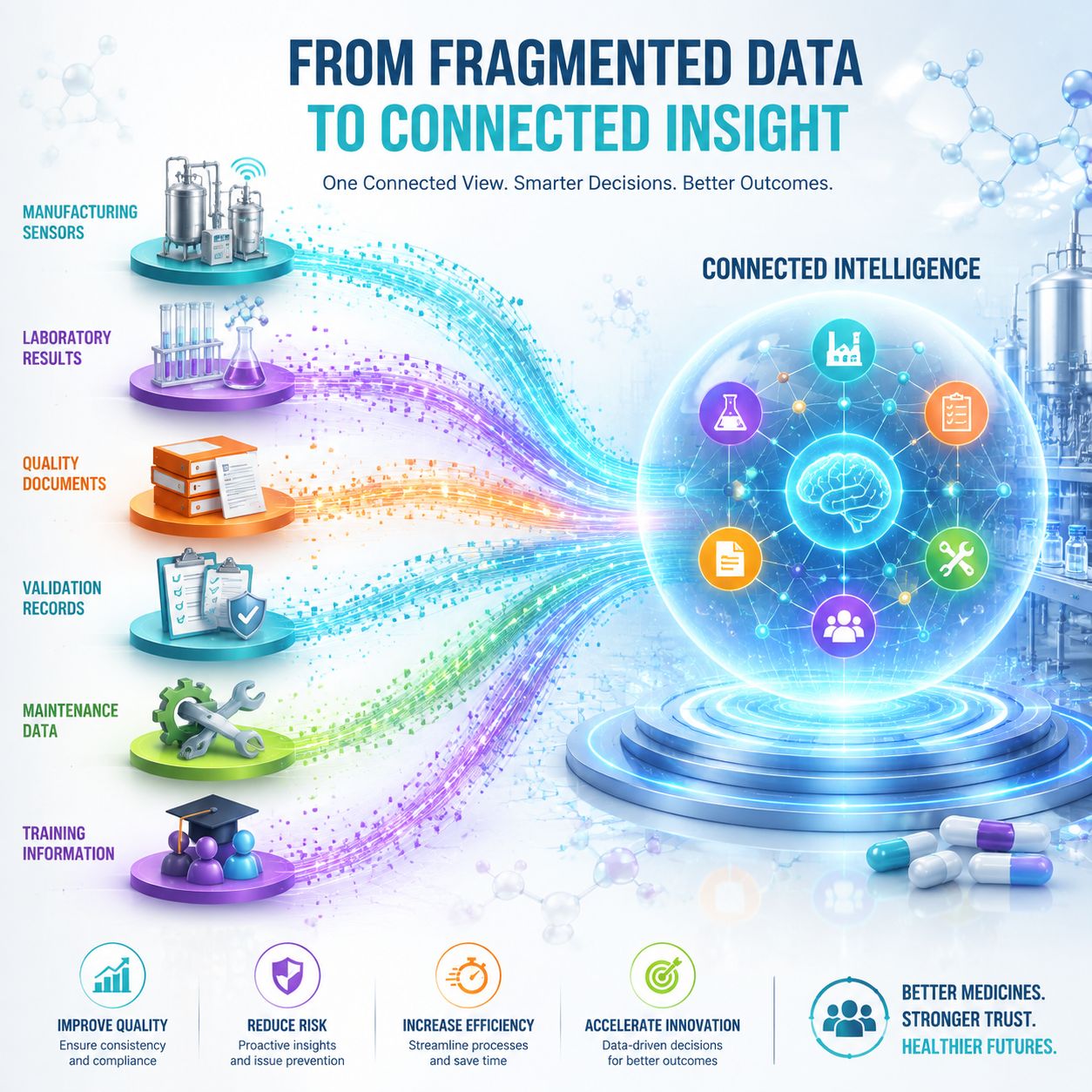
A validation engineer reviewing a software change may need to correlate requirements, test evidence, SOPs, training records, and historical quality data. In most organizations, this information exists, but it is distributed across disconnected systems.
An AI system does not eliminate this fragmentation. It inherits it.
This is why the foundation for AI in regulated environments is not the model itself, but the ability to connect data with context, lineage, and governance. Without that foundation, AI outputs remain incomplete or difficult to validate.
In practice, this shifts the focus from “Which AI system should we deploy?” to “Can our data environment support reliable, auditable intelligence?”
4.0. From AI Experiments to Operational Systems
As organizations move beyond pilots, the challenge becomes how to scale AI in a controlled and compliant way.
In “Audit, Automate, Accelerate: AI Roadmap for Compliant Manufacturing,” published in Forbes Technology Council, the article outlines a structured path for AI adoption in regulated manufacturing, beginning with a clear understanding of existing processes, progressing through targeted automation opportunities, and ultimately scaling validated AI systems across the enterprise.
Read: Audit, Automate, Accelerate - AI Roadmap For Compliant Manufacturing
The framework reflects a practical reality in regulated industries. AI adoption is not a single deployment event. It is an operational transformation that must align with validation requirements, risk management, and quality systems.
Before automation can be scaled, organizations need clarity on process behavior, data quality, and system dependencies. Without that understanding, AI systems risk amplifying existing inefficiencies rather than resolving them.
This is why successful AI adoption in life sciences is less about speed of deployment and more about readiness of the underlying operational environment.
5.0. Data as the Constraint in Manufacturing Intelligence
In pharmaceutical manufacturing, data is generated across a complex ecosystem of systems, including MES, LIMS, historians, quality management systems, and environmental monitoring platforms.
In “Industrial DataOps for Manufacturing: A Practitioner’s Overview,” published in Forbes Technology Council, the article describes Industrial DataOps as a structured approach to managing manufacturing data complexity by ensuring information remains consistent, governed, and accessible across interconnected systems.
Read: Industrial DataOps For Manufacturing - A Practitioner’s Overview
The challenge is not data collection. Most organizations already collect large volumes of manufacturing data. The challenge is making that data usable in a regulated context where traceability, integrity, and context are essential.
Without consistent data structures and governance, advanced analytics and AI systems struggle to produce reliable outputs. This is particularly important in environments where decisions must be auditable and defensible.
DataOps, in this sense, becomes a foundational layer for any form of connected intelligence in manufacturing.
6.0. AI, Validation, and the Evolution of Quality Assurance Models
As AI becomes more embedded in manufacturing and quality systems, it introduces new challenges for validation and regulatory compliance.
In “Annex 22: Why AI Regulation in Pharma Manufacturing Matters More Than Ever,” published in Forbes Technology Council, the article explores how evolving regulatory expectations are shaping the need for robust AI governance, validation frameworks, and data integrity practices in pharmaceutical manufacturing.
Read: Annex 22 - Why AI Regulation In Pharma Manufacturing Matters More Than Ever
Unlike traditional software systems, AI systems are not fully deterministic. Their outputs depend on data, context, and model behavior, which can evolve over time. This creates challenges for validation approaches designed for stable, predictable systems.
As a result, validation is increasingly shifting toward continuous monitoring, risk-based assurance, and stronger integration between data governance and quality systems.
The focus is no longer only on whether a system was validated at a point in time, but whether it remains reliable under changing conditions.
7.0. QA in an Environment of AI Agents
As AI systems become more capable, they are beginning to take on tasks traditionally performed by quality assurance teams.
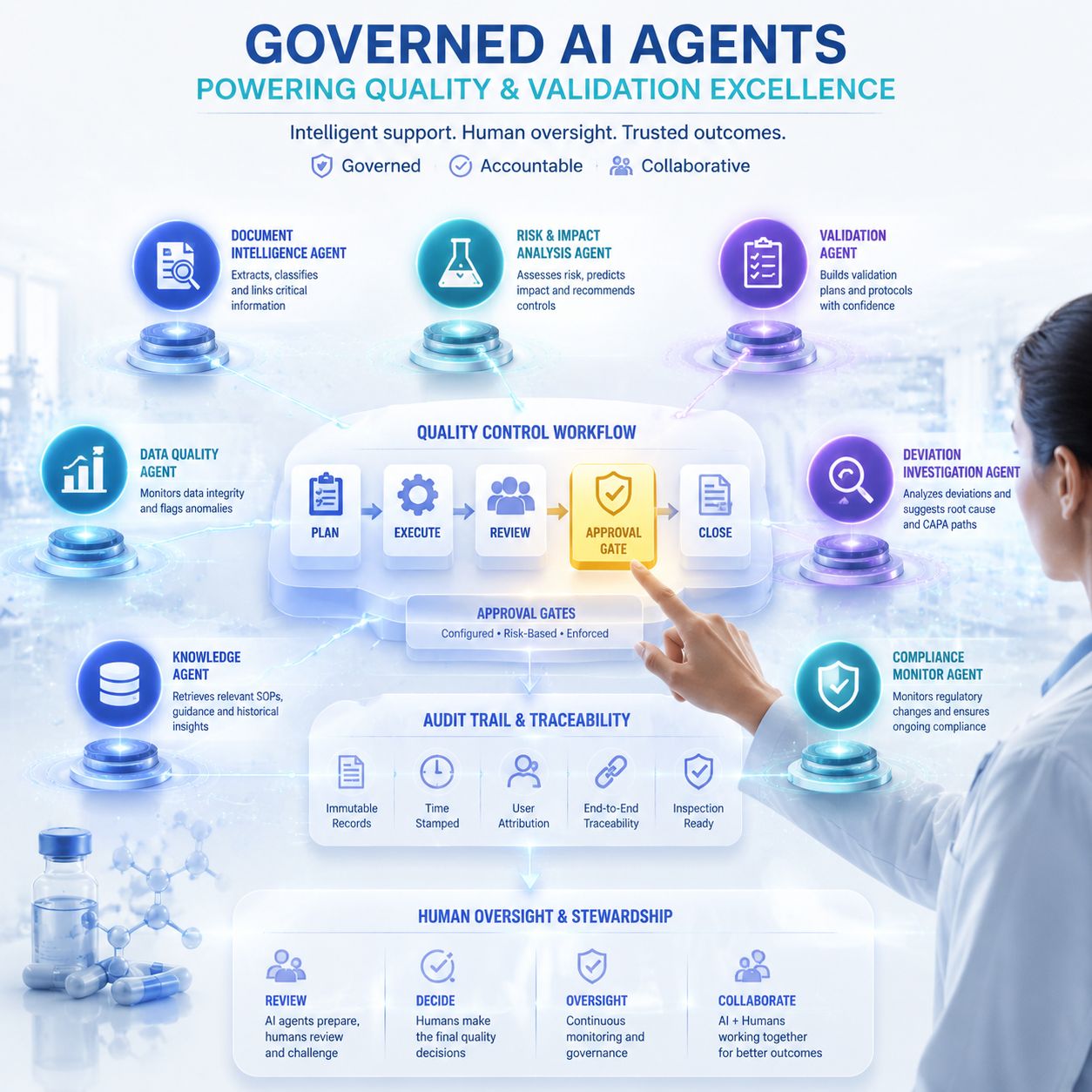
In “The Frontier QA Organization: Governing the Army of Agents in Pharma,” published in Forbes Technology Council, the article explores a future where QA functions evolve into AI-enabled environments, with AI agents supporting structured activities such as testing, traceability, and investigation workflows, while human professionals maintain oversight, accountability, and final decision authority.
Read: The Frontier QA Organization - Governing The Army Of Agents In Pharma
This shift is less about replacing QA roles and more about changing their structure. As AI agents take on operational tasks, QA teams increasingly focus on governance, validation frameworks, and oversight of automated systems.
The central challenge becomes trust. If multiple AI agents are involved in regulated workflows, organizations must ensure they are controlled, monitored, and auditable.
This introduces a new dimension to QA, designing the systems that govern other systems.
8.0. Emerging Architectures for Agentic AI Systems in Life Sciences
Recent work has also explored how AI systems themselves are evolving in structure.
In the article “Loop Engineering & Ralph Loops,” iterative AI architectures are examined that allow agents to plan, execute, and refine tasks in cycles, with implications for regulated manufacturing environments where outputs must remain auditable.
In “Autodata: Meta's Agentic Data Scientist and Its Transformative Implications for GxP Manufacturing AI,” the focus shifts to synthetic data generation and its potential role in addressing data scarcity challenges in regulated AI development.
Read: Autodata - Meta's Agentic Data Scientist
These topics point toward a shared direction which is
AI systems are becoming more autonomous, more iterative, and more dependent on high-quality data environments.
9.0. From Fragmented Systems to Connected Intelligence
Taken individually, these themes span regulatory change, data architecture, AI adoption, QA transformation, and emerging agentic systems. Together, they describe a broader shift in how life sciences organizations operate.
Manufacturing, quality, validation, and compliance are increasingly dependent on the same underlying capability, the ability to connect data, context, and decision-making in real time.
This is where the industry is moving, even if unevenly. Data must become more structured and trustworthy. AI must become more governable. Validation must evolve beyond point-in-time assurance. QA must expand into system-level oversight. And regulatory expectations are beginning to reflect this same direction.
The transition is not simply from manual to automated processes. It is from fragmented systems to connected, continuously operating intelligence across manufacturing and quality domains.
For life sciences organizations, the challenge is not only adopting new technologies, but ensuring that the underlying operational and data foundations can support them in a regulated environment.
The most important shift may be subtle but fundamental, moving from organizations that reconstruct understanding after the fact, to organizations that maintain it continuously as part of how they operate.
10.0. About the Authors
Nagesh Nama
CEO, xLM Continuous Intelligence | Founder, ValiMation
Nagesh is a pioneer in AI/ML-driven GxP compliance with nearly three decades of experience helping pharmaceutical, biotech, and medical device companies navigate validation, data integrity, and regulatory compliance. He is the founder and CEO of both ValiMation (founded 1996) and xLM Continuous Intelligence, the company that first introduced a Continuous Validation platform supporting IaaS/PaaS/SaaS environments compliant with 21 CFR Part 11 and Annex 11. Today, xLM offers a comprehensive suite of continuously validated AI/ML managed services spanning intelligent validation (cIV), predictive maintenance, temperature mapping, and GxP AI agents. Nagesh is a member of the Forbes Technology Council and the Fast Company Executive Board, a contributor to Forbes and Fast Company, and has been featured on Microsoft's AI Agents Vlog. He holds an M.S. in Manufacturing Engineering from the University of Massachusetts, Amherst.
Kashyap Joshi
Program Manager, AI/ML ContinuousOS Apps | xLM Continuous Intelligence
Kashyap Joshi is a Program Manager at xLM, where he leads the implementation of complex AI systems for life sciences organizations by aligning stringent GxP regulatory requirements with next‑generation technology and xLM’s ContinuousOS Suite of Apps to deliver measurable ROI, contin
share this